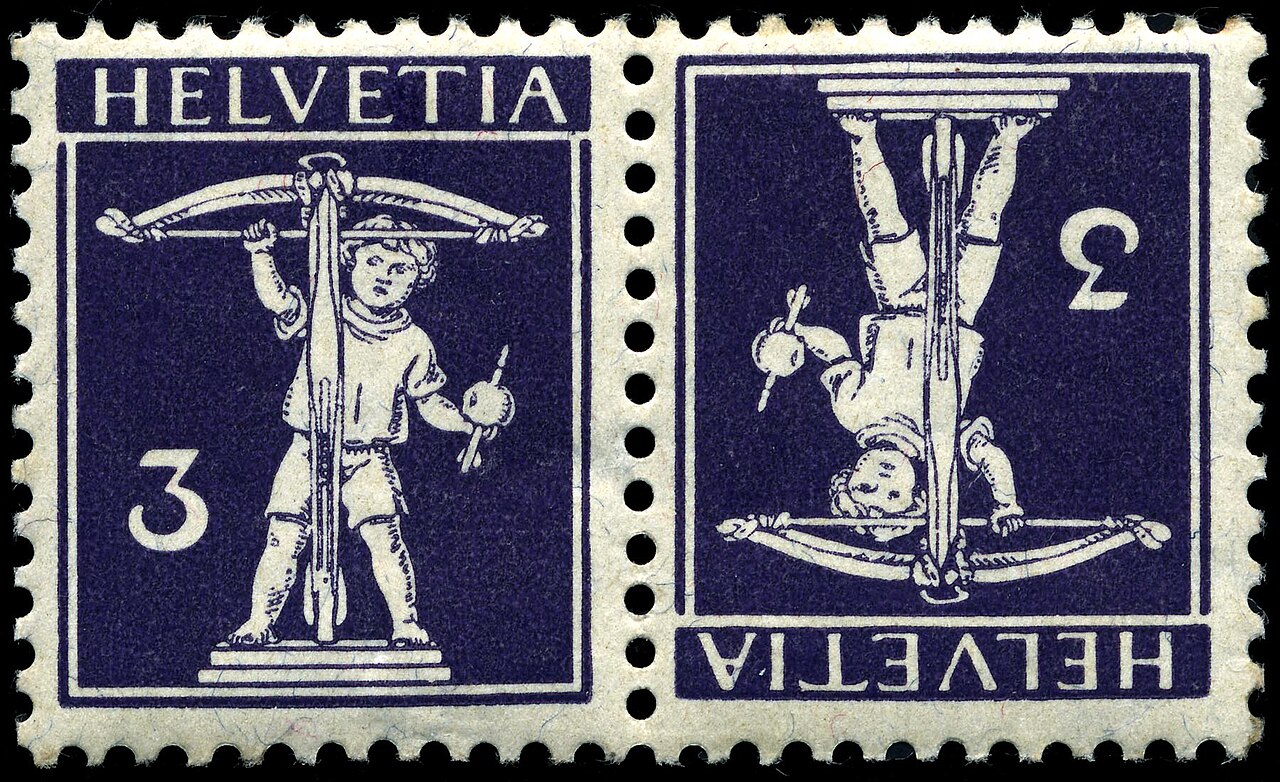
Tête-bêche (pronounced tet-besh)- always with the circumflexes atop the two first e’s please – is adapted from the French for “head-to-tail” (or possibly “head-to-foot”). It’s commonly used in philately for two joined stamps printed one upside down to the other.
Books printed this way are also called tête-bêche; examples can be found back hundreds of years. Unlike the similar dos-a-dos, which are two volumes joined upside-down with two spines, a tête-bêche book has only one spine with two covers. Look at one title, flip the volume on the short end, and see a second title. Though seemingly odd, the joining is useful for a variety of reasons. The use of a single spine for two volumes reduces expenses and increases convenience when two related items are paired. Alice in Wonderland and Through the Looking Glass have been printed in tête-bêche style several times. A 17th century book on Oxford and Cambridge in tête-bêche resolved the problem of which university to feature first.
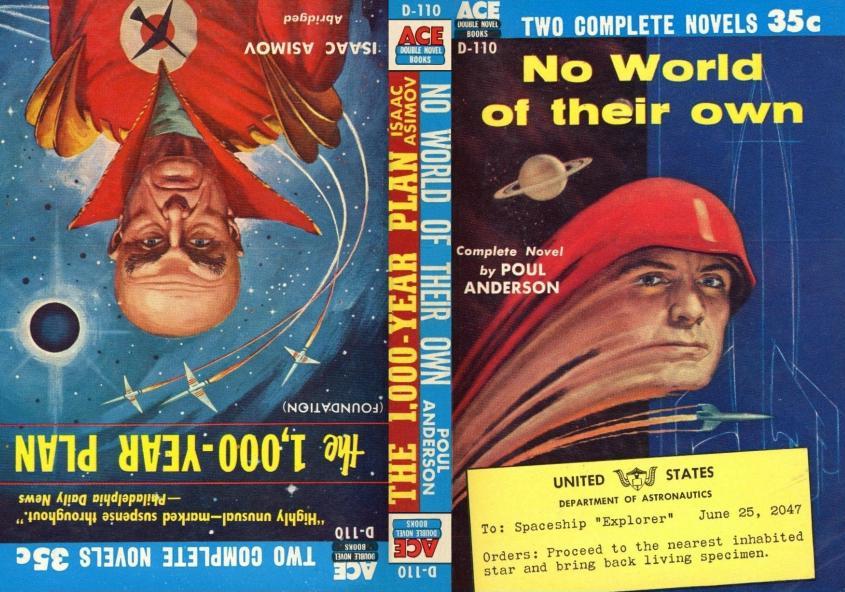
In the modern world, paperback publisher Ace Books used the gimmick to stand out from every other line. Every single release when it launched in 1952 was a double titled tête-bêche, starting with Samuel W. Taylor’s The Grinning Gismo b/w (backed with) Keith Vining’s Too Hot For Hell, both mysteries. Their 31st release was the first to pair two science fiction titles. Ace Doubles, as they were called, soon became almost synonymous with science fiction and are now massively collectible and, for that reason, tricky and expensive to amass all 221 of them.
Another useful tête-bêche trick was to use it to pair two works that commented on each other or gave opposing viewpoints on the same subject. It took a while but publishers finally realized the humorous possibilities, or at least did so after having the possibilities pointed out to them by side-by-side, if not head-to-tail, articles in magazines.
The post-World War I period saw a peak decade for magazines in America, with most of the best writers churning out articles, short stories, and poems for a huge number of titles that paid enormously well. F. Scott Fitzgerald legendarily had his per-story rate raised to $4,000 by the Saturday Evening Post in 1929, twice as much as he earned from royalties on The Great Gatsby and about three times the average annual income. Three of the most collectible humor books originally appeared as articles in huge-selling magazines, combining big names with the evergreen battle of men and women, duals that were also duels, and using the tête-bêche gimmick to give each of the authors their own covers. Down here in the two-dimensional world, I’m resorting to the blah alphabetical order to list the authors.
Oh! Well! You Know How Woman Are! by Irvin S. Cobb b/w Isn’t That Just Like a Man! by Mary Roberts Rinehart (George H. Doran, 1920)
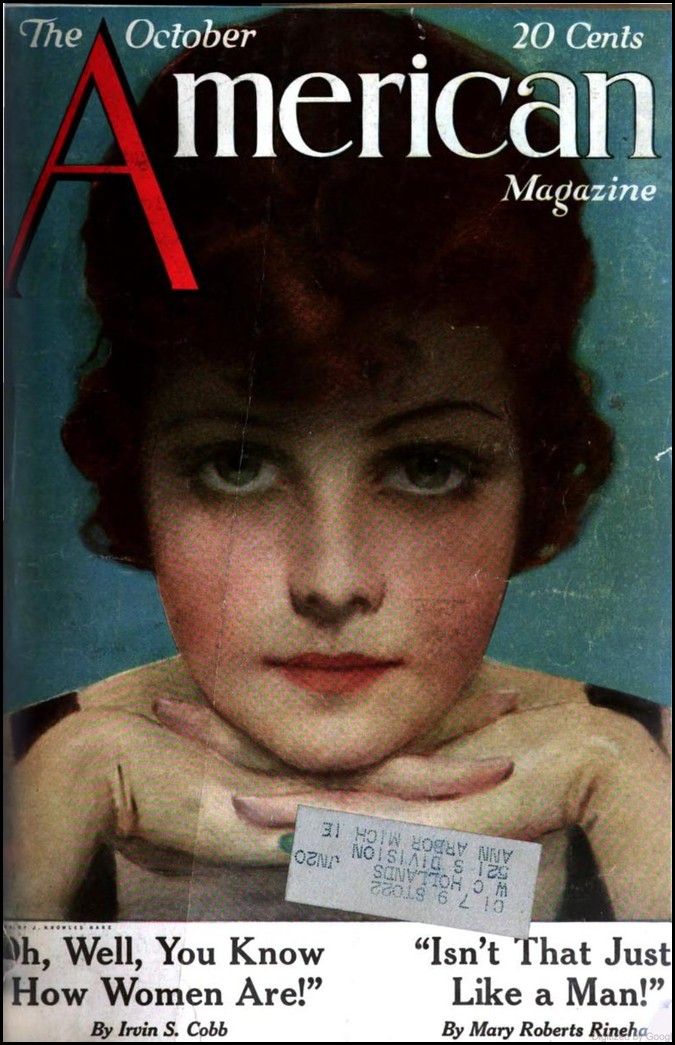
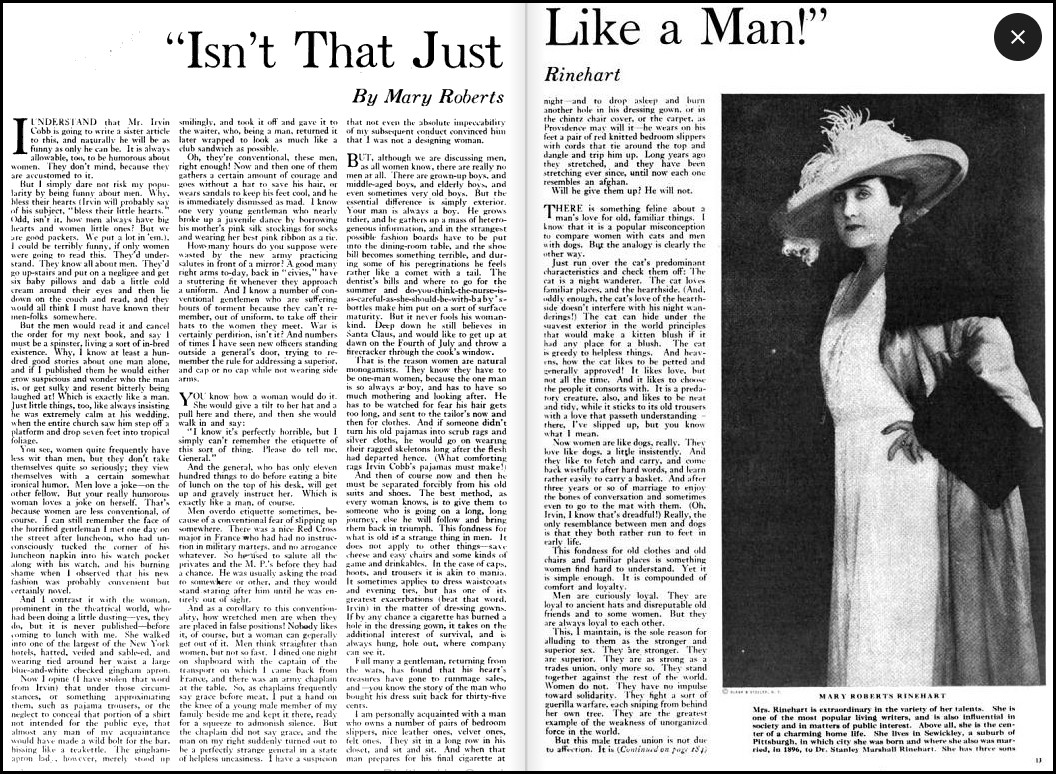
The American Magazine, long forgotten, was a powerhouse after the war, its circulation climbing toward two million. Readers received a fat 250 pages of articles, short stories, serials, and humor. Publishers had already learned to mine the magazines for book material. The December 1919 issue ran a piece by Ellis Parker Butler, a writer of often-reprinted humorous short stories, titled “Poor Old Ellis Parker Butler Is 50 This Month.” Houghton Mifflin snapped it up and published it as a book, How It Feels to Be Fifty, a few months later. Editor John M. Siddall, who had slanted the magazine toward women, always huge purchasers of magazines, lured in two other big names who had already been published in his magazine. “Write a piece about the foibles of the opposite sex!” he probably thundered. The October 1919 issue featured the result up front, illustrated by carefully posed photos of the authors.
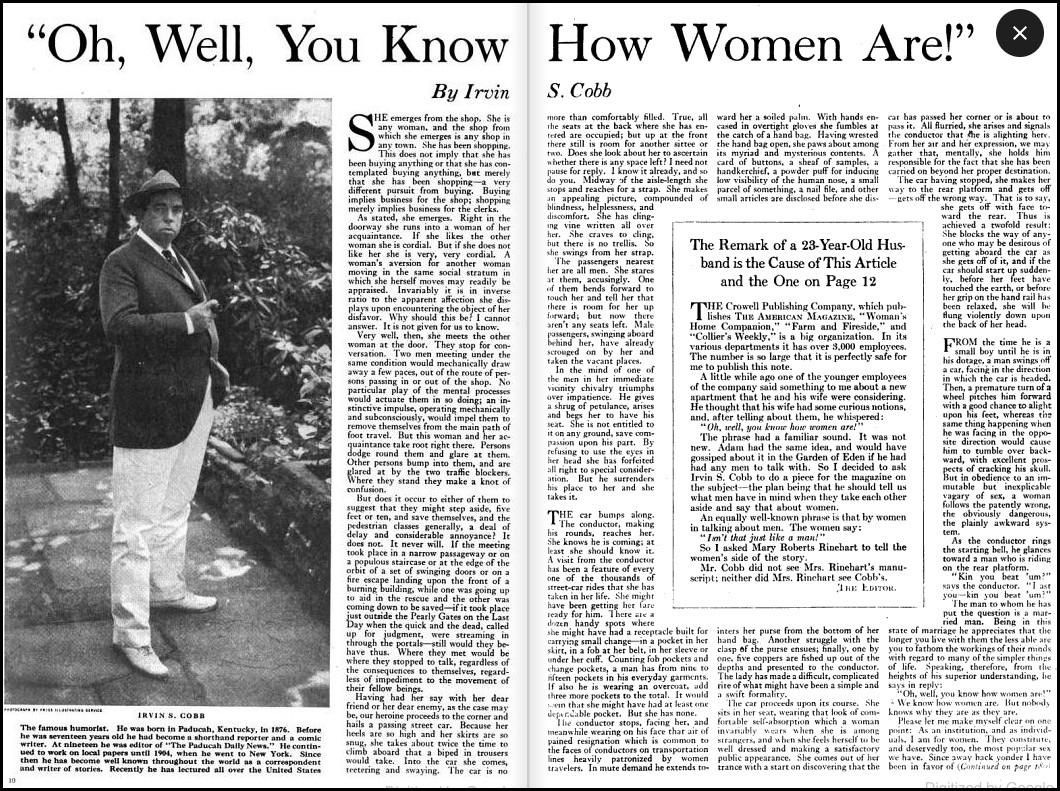
In 1919, Irvin S. Cobb (1876-1944) was more than a decade and 200 short pieces into a nonfiction career as a reporter and war correspondent for the Post and fame as a short story writer whose works were compiled into more than a dozen books. He created the character of Old Judge Jones, a solver of mysteries who had a run as one of the most popular American detectives. That year, not a very busy one, he published more than a dozen magazine pieces of fiction and nonfiction, most for the Post, in addition to his sports column and general reporting. He reached what might be a peak for any humorist in 1920, when he and Ring Lardner, bored beyond reason by the failure of voters at the Democratic National Convention to settle on any compromise candidate, started a joke feud in their columns. Since no votes seemed to make any difference, some equally bored delegates wrote-in their names during the 23rd ballot. Cobb beat out rival Lardner 1 1/2 to 1/2.
By 1919, Mary Roberts Rinehart (1876-1958) not only could match Cobb story for story but she was the most famous and bestselling mystery writer in America. Her first novel – The Circular Staircase, which saw magazine serialization in 1907 and book publication in 1908 – launched what Ogden Nash satirized as “Had I But Known” mysteries, books in which heroines keep putting themselves foolishly into perilous situations. Humorists can only depend on satire to work the subject is instantly understood by audiences. The novel sold over a million copies and has been reprinted regularly for over a hundred years. Rinehart converted it into a hugely successful Broadway play that ran for more than two years and three movies were adapted from that. Legions of imitators followed in every genre: horror films (and their satires) grossed billions from characters who foolishly decide to run toward rather than away from masked characters with knives.
Publisher George H. Doran had it within hard covers less than six months later. Cobb already had a number of humor books to his credit, but this is Rinehart’s only entry into the genre, although some of her mysteries prefigured screwball comedies.
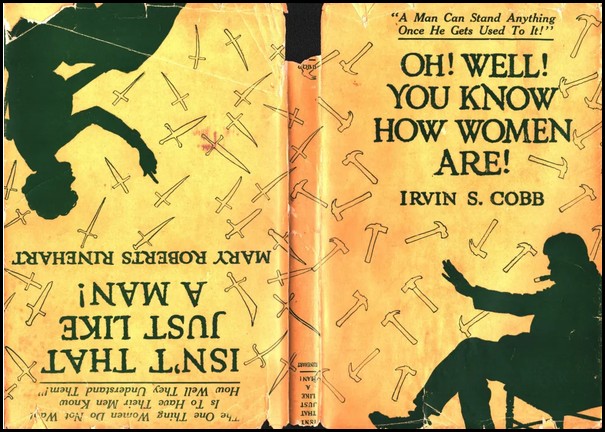
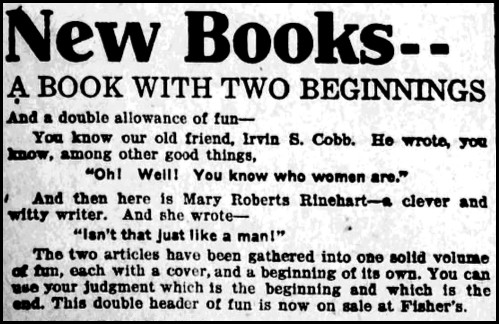
If the names weren’t enough, the novelty aspect of the book made for irresistible advertising.
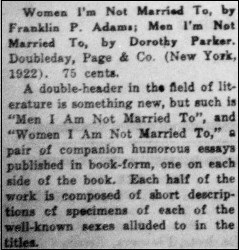
Women I’m Not Married To by Franklin P. Adams b/w Men I’m Not Married To by Dorothy Parker (Doubleday, Page, 1922)
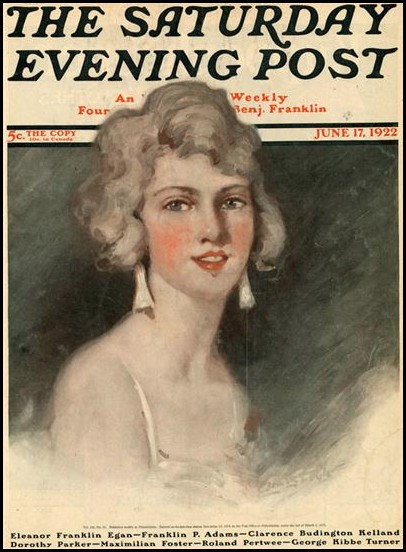
That cute of an idea couldn’t stay untouched. Editors and publishers put it into a mental tickler file. George Horace Lorimer, the editor of the Post, must especially have been peeved that two of his regulars gifted a competitor with a gimmick that got national attention. Lorimer had been editor for over two decades, smashing the Post past the two million circulation barrier, an envied and rich institution that may have been the premier magazine in the country. Authors who appeared in the Post in 1922 included Irvin S. Cobb, Ring Lardner, Nina Wilcox Putnam, and Mary Roberts Rinehart. Flush from having his pick of the famed and prolific, Lorimer didn’t need to be an imitator, but the idea kept tickling at him until he commissioned two names he had already published in 1921 and 1922 and who were known for pithy and sometimes acidic comments. The piece ran in the June 17, 1922 Post.
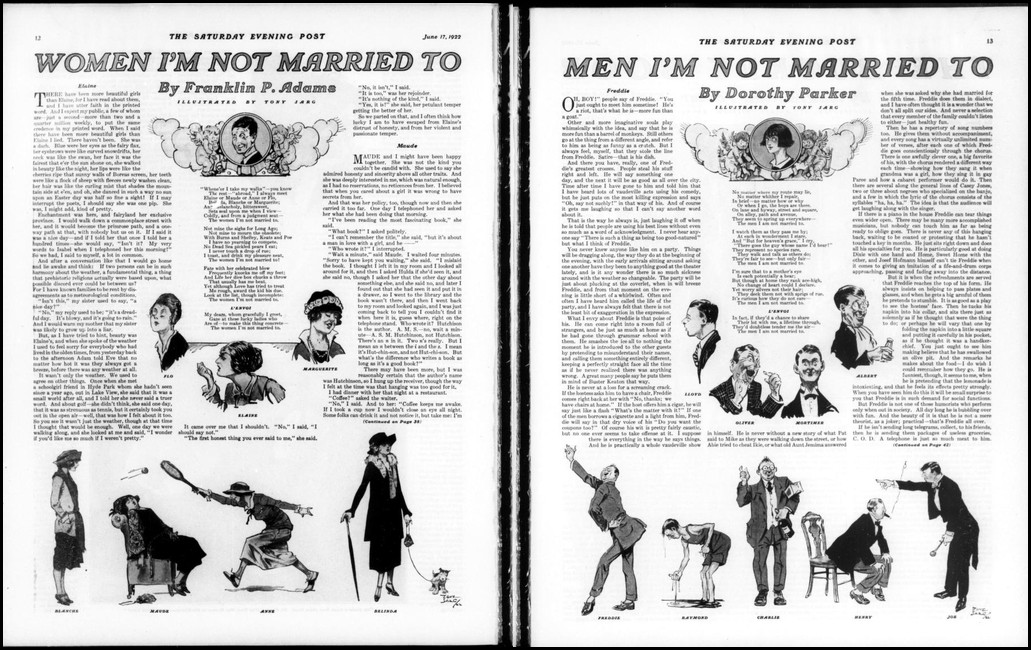
Dorothy Parker (1893-1967) is remembered one of the most celebrated wits of the 20th century, but she had to climb the ladder to achieve that status. She got her start at Vogue writing uncredited captions under pictures. Vanity Fair magazine hired her to do theater reviews but fired her after she insulted one too many prominent Broadway figures. That of course endeared her to the in-crowd that became known as the Algonquin Round Table, where she became a fixture at their boozy Prohibition lunches. Most of her work has been in print for a century but her book output is almost entirely limited to short stories and poems. Unless you count her collection of often hilarious New Yorker book reviews, Constant Reader, this would be the only book of prose humor to appear under her name. Calling it a “book” is flattering it, since again this is a 50 or so page reprinting of dual magazine articles.
Franklin P. Adams (1881-1960), known as F.P.A., was by far the more celebrated at the time. In an era in which New York newspaper columnists could command national attention, Adams’ column for the New York Tribune had been running for almost a decade. By compiling celebrities’ witty sayings, not credited to the press agents who were their true authors, interspersed with pungent observations written by Adams, his name and fame transcended any of the other Round Table fixtures in 1922. Getting truly funny contributions from his true author friends delighted him. Parker achieved much of her contemporary fame from poems in the column; she hadn’t yet published a short story and the Post article was one of less than handful. Being able to insert your own poetry in a daily column, syndicated to other newspapers, gave Adams a gigantic audience. He had already published a stack of books of his poetry. As with Parker, he was not given to long-form prose humor. This is his only book not from his column that fits into my collection. Women I’m Not Married To b/w Men I’m Not Married To is therefore a unique volume from two famous humorists.
Doubleday, Page pounced on the opportunity and released the pairing as a tête-bêche book in time for the Christmas audience.
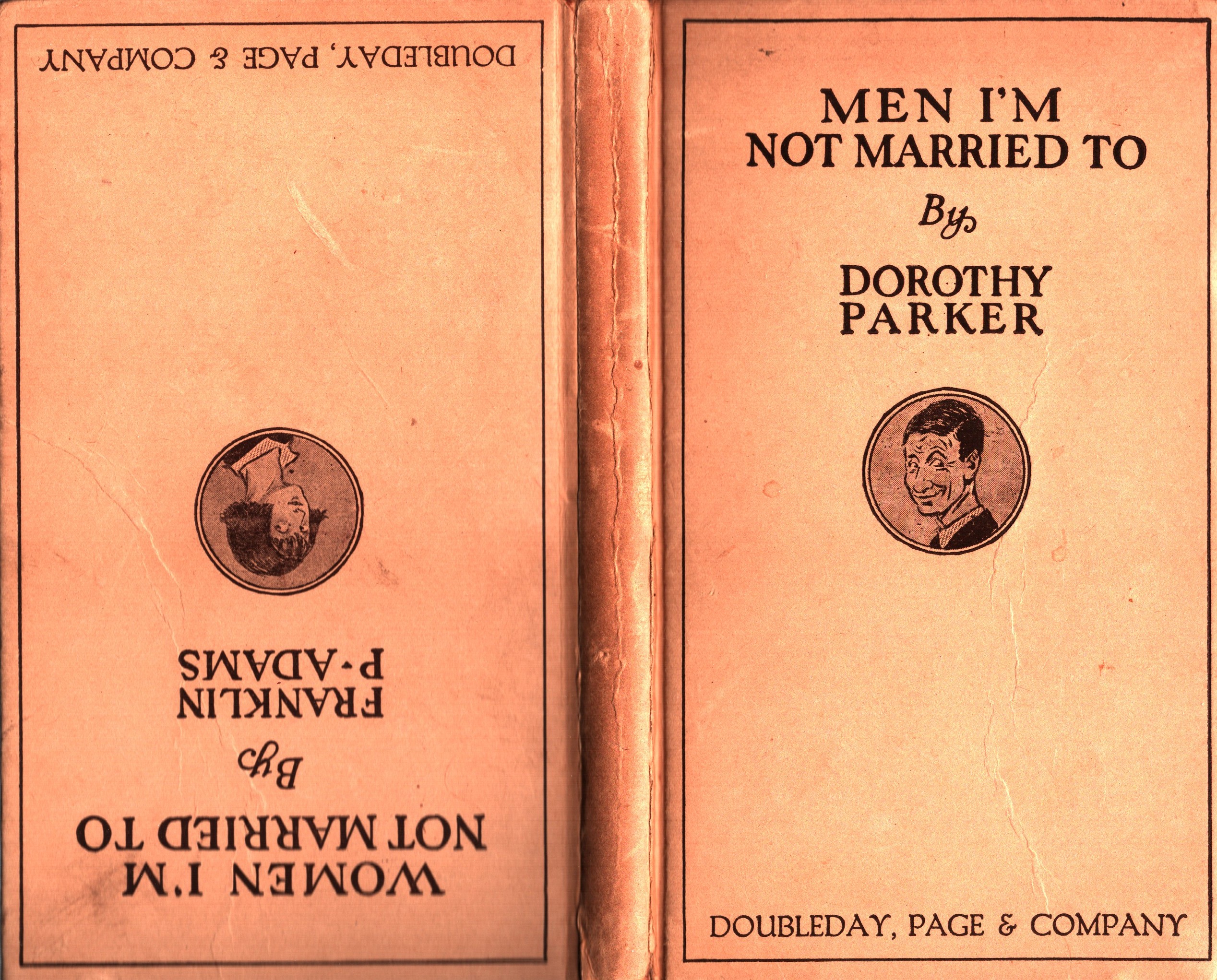
You’re not missing anything. The dust jacket is identical to the boards.
Something I’ve found through thousands of hours of newspaper research is that either nobody in journalism had long-term memories or that editors demanded that every novelty be proclaimed as something brand new, never before seen. Despite a well-reviewed book just three years earlier, contemporary reviewers treated the Adams-Parker release as they would a newborn unicorn.
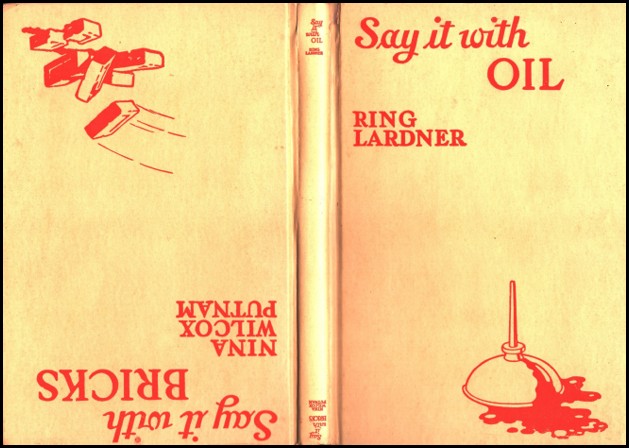
Say it with Oil by Ring Lardner b/w Say it with Bricks by Nina Wilcox Putnam (George H. Doran, 1923)
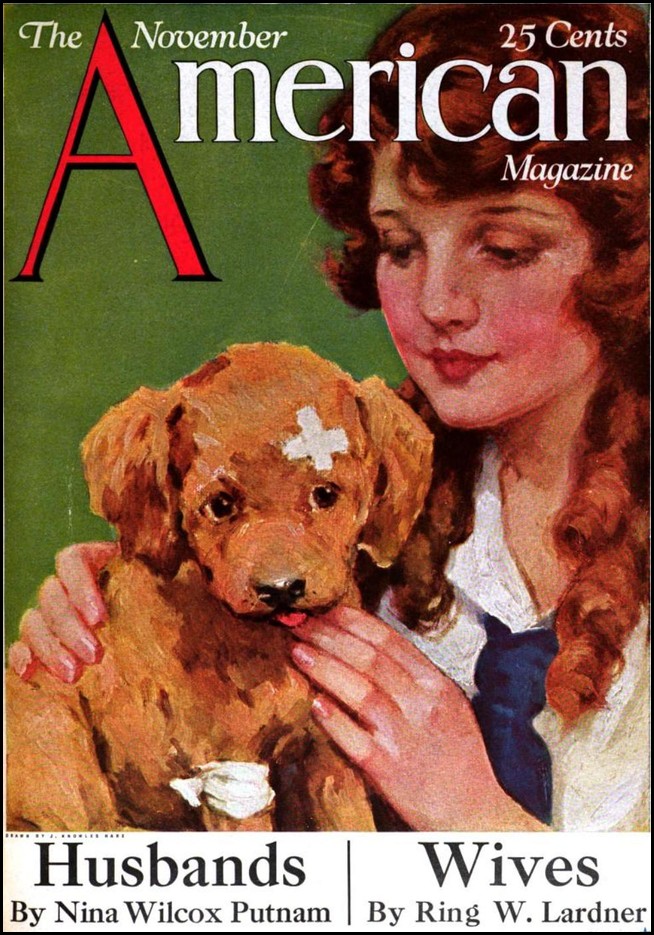
We’ll never know, but I like to think that John Siddell over at the American was vexed by Lorimer’s piracy. Or maybe he knew ahead of time that Lorimer had commissioned the article; the New York world of publishers, editors, authors, and columnists lived in close proximity, went to the same restaurants and speakeasies, attended the same first nights at Broadway shows, and often were to be found together in bed. Secrets were impossible. Besides, Lardner had already in 1921 published a book, Symptoms of Being 35, that had run in the magazine as “How It Feels to Be Thirty-Five.” (Hmm. Remember Ellis Parker Butler at 50?) In any case, a duel redux got bannered on the cover of the November 1922 American Magazine. Taking no chances – Parker might have been funny but she was a relative nobody – Siddell tapped two writers who rivaled any of other famous names on this page.
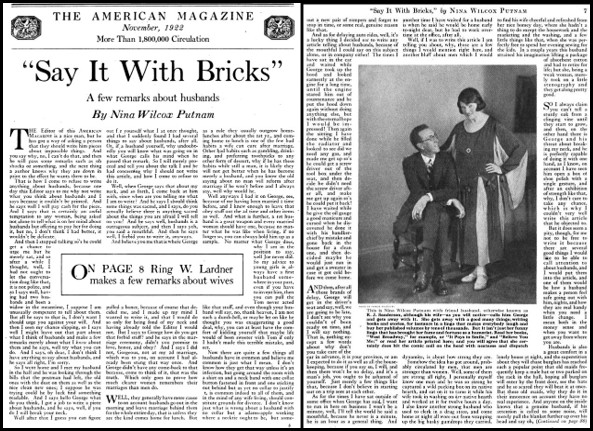
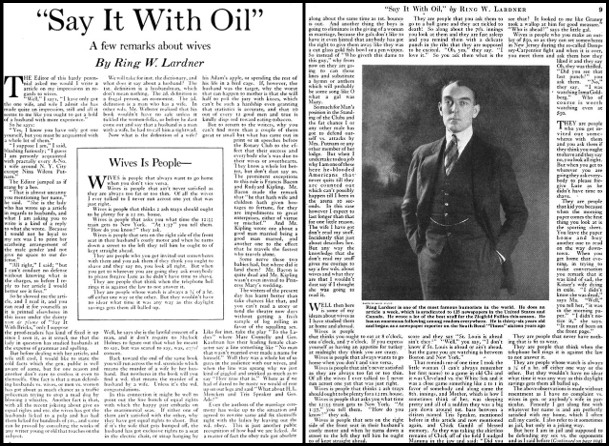
Ring Lardner was the most important and widely read humorist of the 20th century. I didn’t say that, famed academic of period literature Matthew J. Bruccoli and his grad student Richard Layman, who wrote his PH.D. dissertation on Lardner, make the claim in their Ring W. Lardner: A Descriptive Bibliography. Contemporaries of Lardner (1885-1933) would undoubtedly agree. He was the humorist’s humorist, the one they all looked up to for his craft. Ringgold Wilmer Lardner had an especially good name to shorten for purposes of publication. His sportswriting career started when he was twenty. A decade later his Chicago Tribune column, In the Wake of the News, was syndicated to over one hundred newspapers. Sports reporting was the main attraction but any subject might get covered, sometimes purely fictional. He wrote in the vernacular of the little-educated baseball players he covered, making them funny and the object of fun, with the finest ear in the business. Millions of words poured out of him, giving him a salary of up to $100,000 in the 1920s.
Nina Wilcox Putnam epitomizes the immensely successful and totally forgotten humorist. Another of the phenomenally prolific authors of her era, she wrote an endless list of short stories, books, and articles. Her Associated Press obituary certainly underestimated her production.
She wrote more than 500 short stories, 12 articles, and a syndicated column, “I and George,” that was carried in some 400 newspapers in the 1920s…
By 1942 Mrs. Putnam was estimated to have earned more than a million dollars from her writing.
Not mentioned are her children’s books, including the Sunny Bunny series, or her daily one-panel cartoon Witty Kitty. Or that a story of hers was the basis for the 1932 movie The Mummy, along with at least fifteen other films that were adapted from her work.
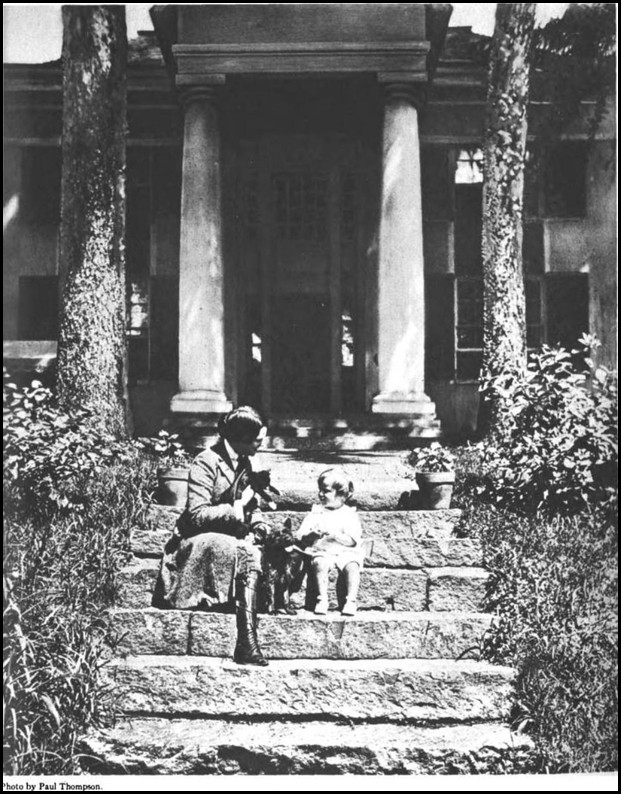
Richer than Lardner, she lived in Greenwich Village and sometimes Palm Beach in Florida. She maintained a residence in Hollywood after she signed a $50,000 contract as production manager on films made from her stories. She always wanted a castle in Spain so she bought one. American Magazine did a story featuring her country house in Connecticut. The “I and George” column got her billed as “America’s Only Women Humorist,” although you can’t believe everything you read in a newspaper.
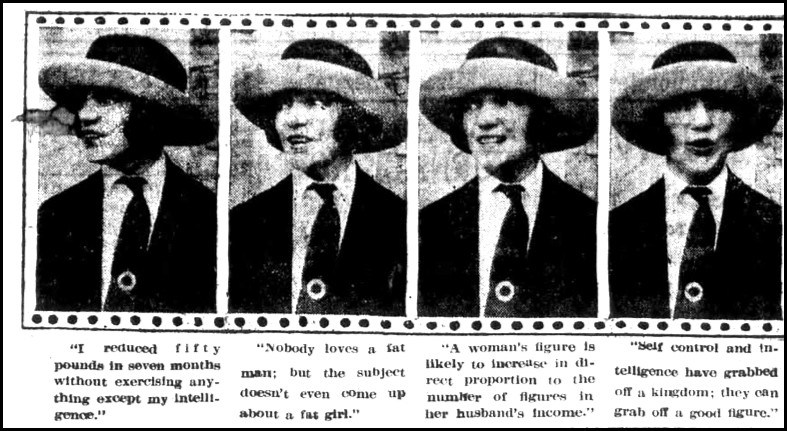
Lest you think she wasn’t as famous as I say, she was in every newspaper in 1922 with a report that she had lost 50 pounds without exercising, doing it all by dieting and avoiding about a million foods. As you can see from the captions below, much about society has changed in the last century. A book, Tomorrow We Diet, emerged just a few months before the dual duel with Lardner.
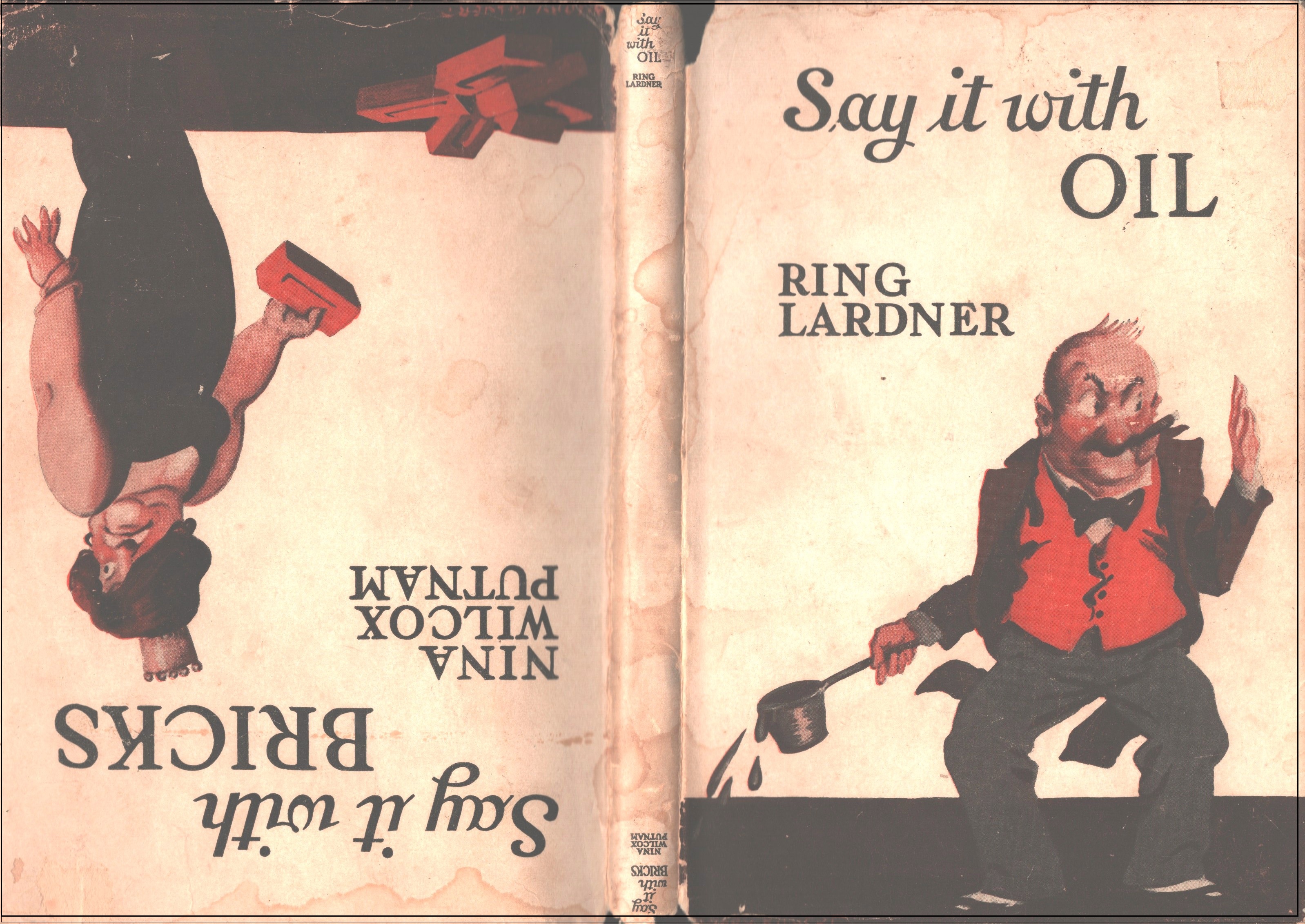
Bibliographic note. After the two already mentioned publishers merged in 1927 to create Doubleday, Doran & Company, the new firm reprinted this book. Only the title page with the new firm’s name is a clue of reprint status. Buyers could easily mistake that volume for the true first edition.
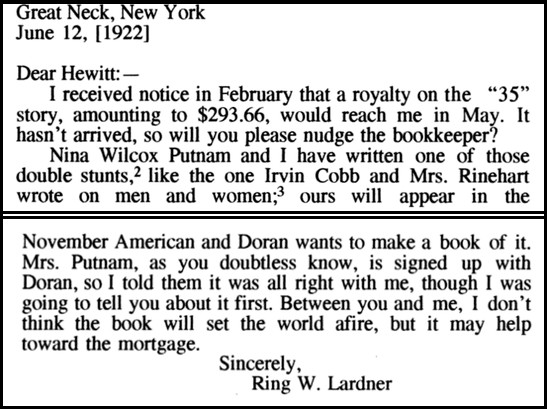
The brief fad of tête-bêche books reprinting magazine articles is something of a mystery. On the one hand, a biography of Cobb includes a laconic statement that “The book sold well.” On the other, Lardner thought that the practice was hardly worth the effort.
A letter that Lardner wrote to Hewitt H. Howland, his editor at publisher Bobbs-Merril, about his previous magazine-article generated book Symptoms of Being 35 makes this clear. (You might remember Howland’s name from my article on The Laugh Club. He was married to Irvin S. Cobb’s sister. The New York word scene was interrelated in every way.)
It may have been simply the format. Tête-bêche books remained uncommon for the next century. To this day, seemingly every time any publisher or author releases the format in any genre, eyebrows raise and commentary on its oddness ensues. I have fewer than a half dozen later humorous others in my collection. As a prime example of their timidity to resurrect the format, publishers waited another three decades before dipping a toe back into humorous tête-bêche. And they played safe by dipping back into the pool of man/woman cliches.
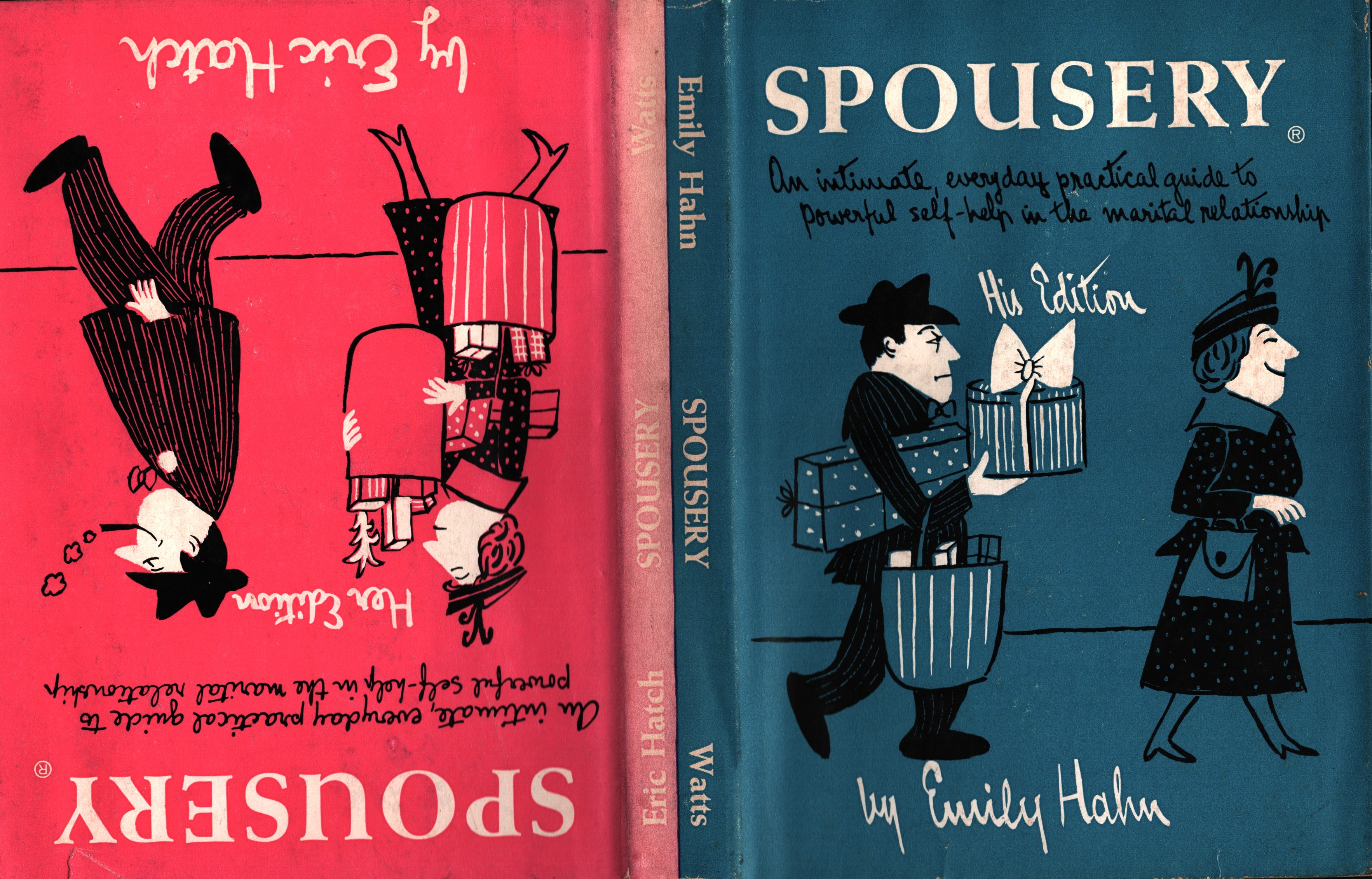
Emily Hahn (1905-1997) wrote more than fifty books, although only her first can be classified as pure humor. She had confounded every cliche about the capabilities of women since becoming the first female at the University of Wisconsin to earn a degree in mining engineering. Using that to write a book on diamonds – excerpted in The New Yorker where she had been a regular and published almost simultaneously with Spousery – she dominated articles and reviews. Eric Hatch (1901-1973), though, was known for his comic novels, including one that became the classic movie My Man Godfrey. He also had been on the staff at The New Yorker. Both authors were married, although not to one another. They didn’t even bother to coordinate their writing, doing their work separately without ever meeting.
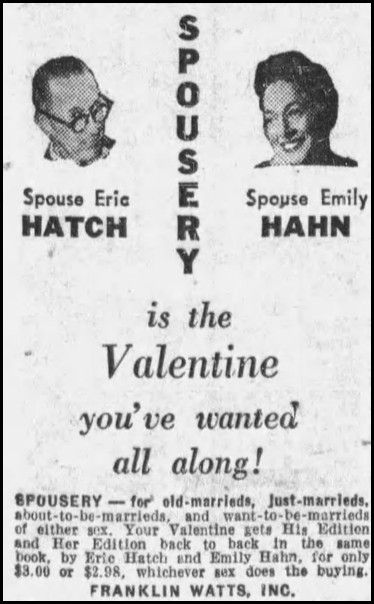
The book had a second gimmick. Hatch’s front flap listed the price as $3.00. Hahn’s front flap gave a special women’s price of $2.98. How booksellers coped was not recorded for posterity.
Magazine articles continued to spawn hundreds, perhaps thousands, of titles over the last century, but books that reproduce brief articles of any type remain rare. Perhaps the gimmick should be revived for today’s book world, to tempt more readers into buying specialty titles. You can’t do tête-bêche on a computer.
October 1, 2026


You must be logged in to post a comment.