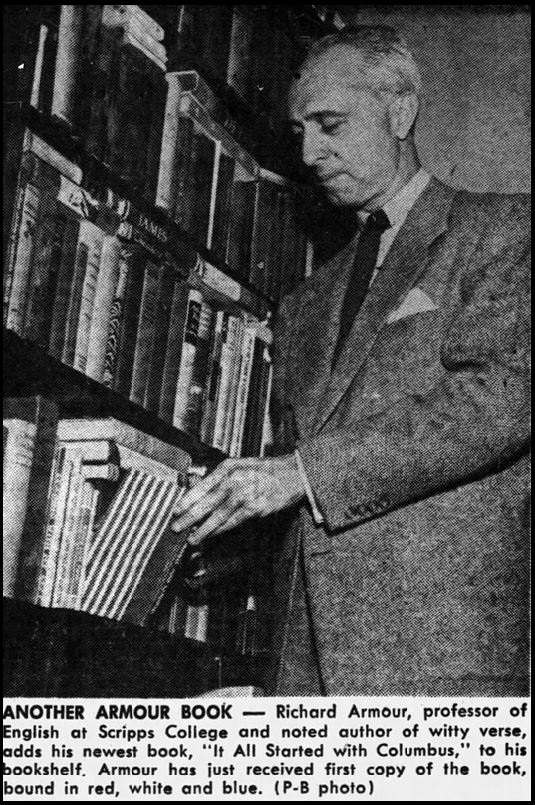
Richard Armour credited himself with 10,000 pieces. Four zeroes. He was the most prolific writer of short comic verse in the 20th century, probably of all time. Those don’t count here, but his two-dozen-plus humor books, many of them as well researched as the ones by Forgotten Humorist Will Cuppy, certainly do. How did he find the time? For one thing he had a day job, Dean of Faculty and Professor of English at Scripps College and the Claremont Graduate School, both in Claremont, CA, where he had in 1927 graduated from Pomona College. The loop included a Ph.D. in English philology from Harvard and visiting professorships at a bunch of other universities. He was reputed to have made his students stand when they addressed him.

If you were compiling a list of the least likely candidates for a side-career in writing humor, Armour would surely be near the top. And light verse for slick popular magazines? You’d think the poems alone would blot out all free time. You think Ogden Nash wrote this classic?
Shake and shake
the catsup bottle.
None will come
and then a lot’ll.
Nope. That was Armour. He had a syndicated newspaper poetry column. Who else can say that?
But humorous poetry isn’t what this site is about. Not that it isn’t forgotten. Other than one or two quatrains, Nash himself, the master of masters, is barely a thing. Dorothy Parker is remembered more for her one-liners than the books of poetry that made her reputation. Samuel Hoffenstein was as famous as she was. I rest my case.
So forget the poetry, collected in about a dozen volumes. Also ignore the dozen or so children’s books he wrote. And the serious books. With prose humor there’s only one place to start, and that’s with Columbus.
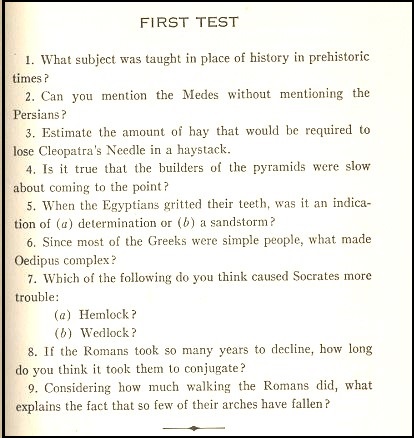
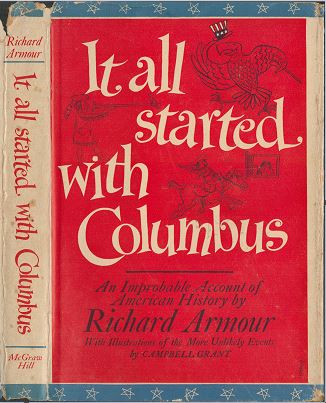
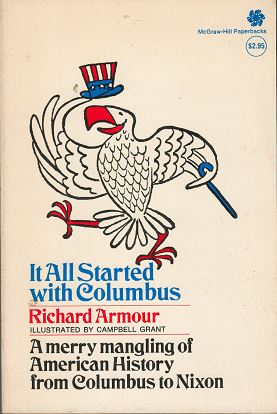
It All Started with Columbus appeared in 1953. A parody of American History textbooks, it came complete with numerous footnotes, scattered tests, a mid-term project, and a glossary of terms. The footnotes were full of puns, the tests contained unanswerable questions, and the glossary hearkened back to Ambrose Bierce’s Devil’s Dictionary. (Communist: 1. A Communist. 2. (Americanism, unfortunately not yet obsolete) Anyone who disagrees with you.) OK, the entire book’s light-hearted look at history – about as satiric as pre-PC America could stand in 1953 – certainly owed much to Cuppy’s 1950 The Decline and Fall of Practically Everybody, and both were stolen entirely from Sellers and Yeatman’s classic 1066 and All That, which, being British, is out of my purview no matter that a million books have copied it down to the last footnote. As a trained academic, Armour was scrupulous about citing: the book’s dedication was directly to Sellers and Yeatman. Illustrations were profusely provided by Disney animator Campbell Grant.
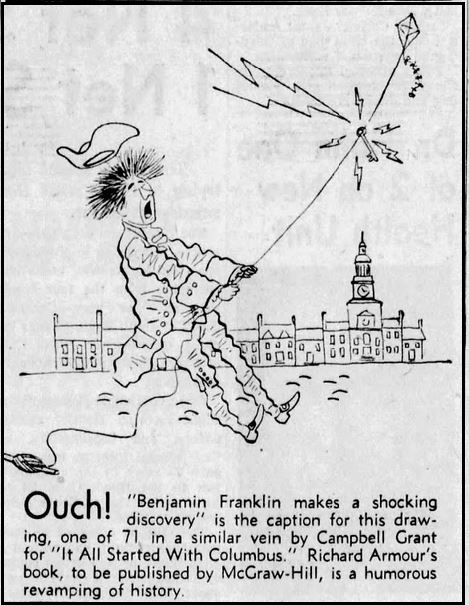
Cuppy, as you’ll see in his entry, had the misfortune to die before the book saw print. Armour had more foresight. Besides, with his name appearing in every magazine and newspaper that readers might happen to open, he was a brand that advertised itself through sheer omnipresence, like Coke. Columbus, full of – carefully neutral – appraisals of presidents, benefited by careful timing, appearing just after Eisenhower took office, when the country was reeling from the transition. A million copies later, Armour updated the book for the seventeenth printing, just after Kennedy’s inauguration. Another edition took the history through Nixon and a few years later one last chapter ended with the Bicentennial and Ford. Readers probably never knew he was a proud Democrat.
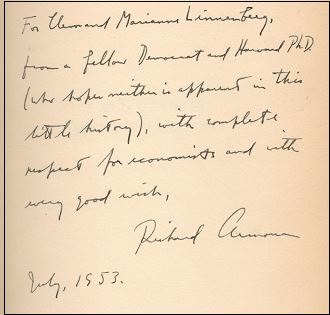
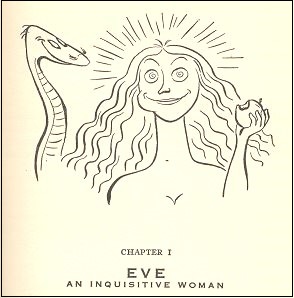
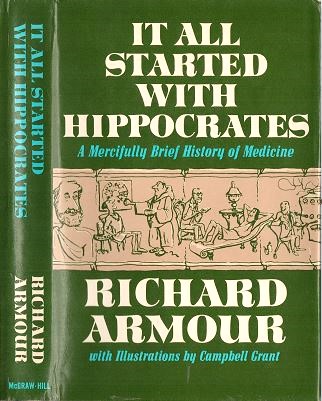
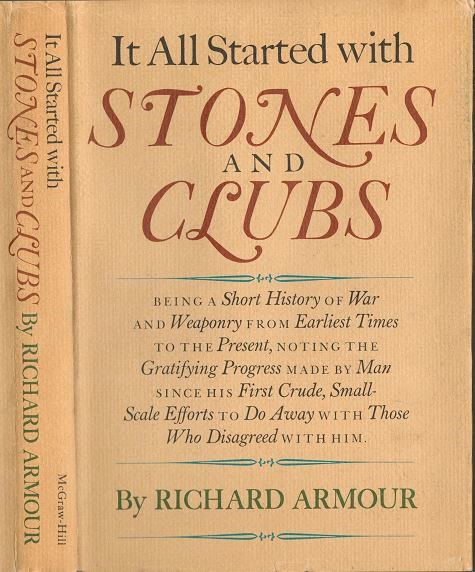
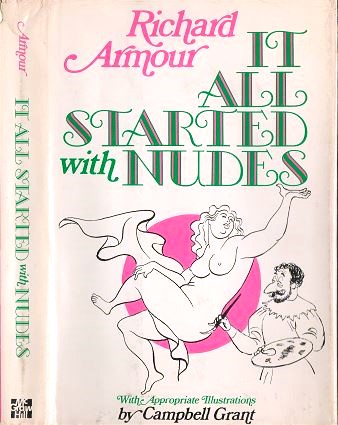
Columbus was a career all by itself. Neither Cuppy nor the Brits penned a marketable follow-up, but the uberprolific Armour was a fountain of words. He soon let loose with the It All Started With… series, featuring Eve (women), Europa (European History), Marx (communism) , Hippocrates (medicine), Stones and Clubs (war), Freshman English (literature), and Nudes (art).

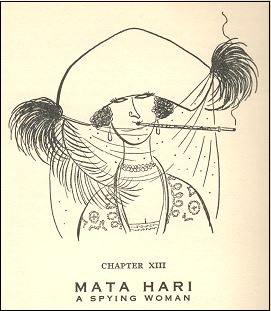
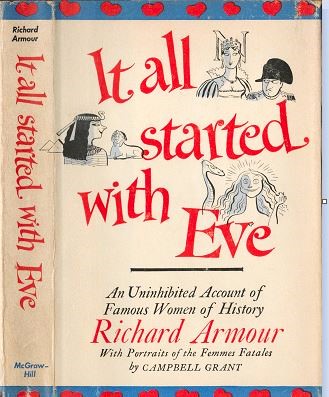
Eve was a conventional set of short biographies from Eve herself to Mata Hari, his only selection from the 20th century.
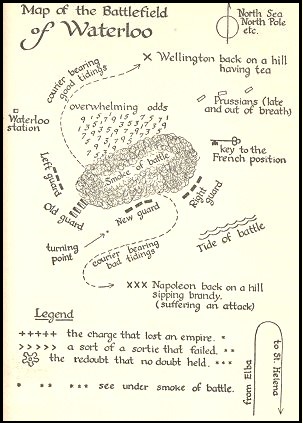
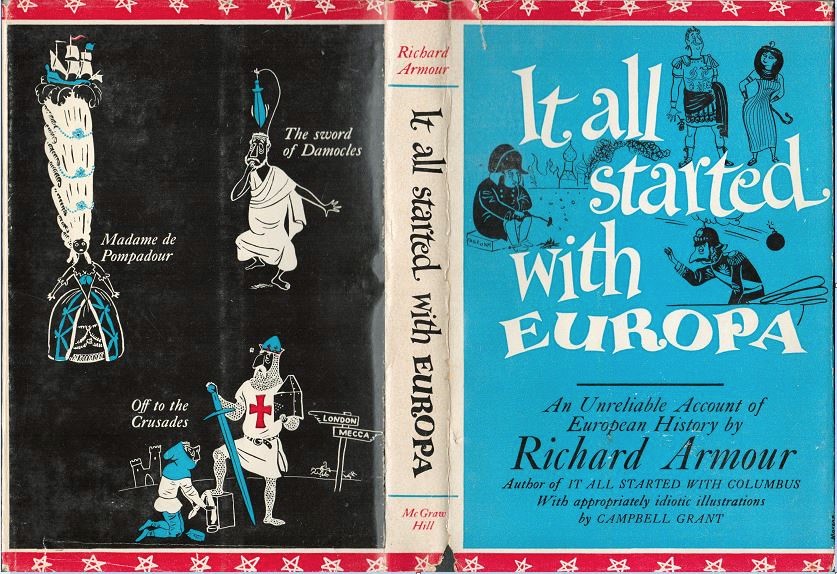
Europa went back to textbook style, with more tests, more clever drawings by Grant, and even maps.
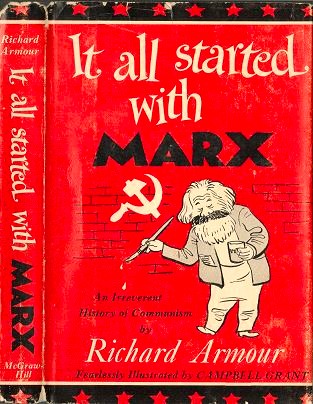
Since this was the 1950s, Americans thought of the menace of Communism every moment, hammered into them by every type of media, all of them dependably right-wing and anti-Communist. You don’t find many humorists tackling the subject during the fifties, so I have to admire Armour for daring to do It All Started With Marx in 1958, just after the Soviets had thoroughly embarrassed and frightened Americans by launching the Sputnik satellite.
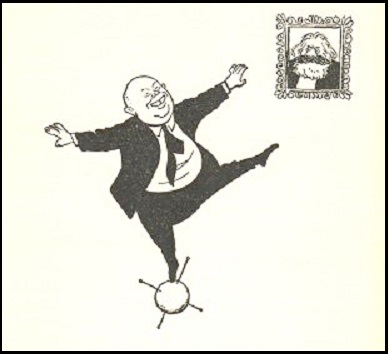
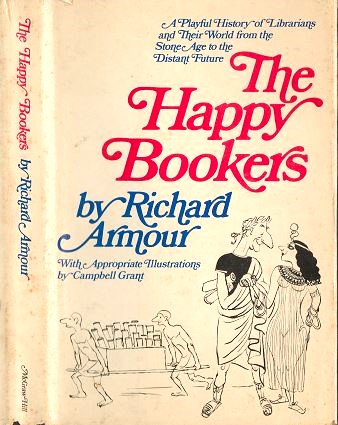
Virtually all humorists make connections with readers by pitching their humor to the manners and mores of their times. Forgotten Humorists Corey Ford and Oliver Herford are very much examples of that. Armour’s later humor spoofed the times, the 1960s and 1970s, given such prodigious amounts of material to work with. I mention that because I needed to somehow work in this illustration by Campbell Grant, from the 1976 history of librarians, The Happy Bookers.
Aside: That odd title doesn’t resonate today, but it was a pun on call girl Xaviera Hollander’s 1971 memoir The Happy Hooker. Ghostwritten as it was, the book sold over 20 million copies and everybody in the 1970s would have instantly understood the reference. Spoofing the times indeed.

As is true for almost every Forgotten Humorist except Cuppy, Armour’s early humor made his reputation and is the stuff still worth noting. His work then included large numbers of contemporary references for contemporary audiences but cast them into a framework of timeless larger subjects. Histories had long been used by American humorists to spoof the world at large. Nineteenth century humorist Bill Nye topped off his career in 1894 with Bill Nye’s History of the United States, sequeled two years later by Bill Nye’s History of England, which despite its thickness only got to Henry VIII. (He died. Well, both of them did, but Nye had half a history to go.) Forgotten Humorist Donald Ogden Stewart introduced himself to the literary community by attempting a feat as difficult as a triple axel. His A Parody Outline of History in 1921 not just narrated a series of incidents from American history but did each one in the style of a different contemporary bestselling author. Master humorist poet Don Marquis collected his curmudgeon’s character’s thoughts in Old Soak’s History of the World in 1924. Cuppy planned on a world history to be his masterwork.
Armour was the first and still the only humorist to take on the entire high school curriculum and drop a satire bomb on it. We lament about the lack of knowledge of American history of today’s high schoolers; It All Started with Columbus requires readers to have some knowledge of hundreds of bits of American history, a veritable textbook’s worth. All his It Started With books make extraordinary demands on readers’ knowledge of broad topics. Yet they kept being smash hits.
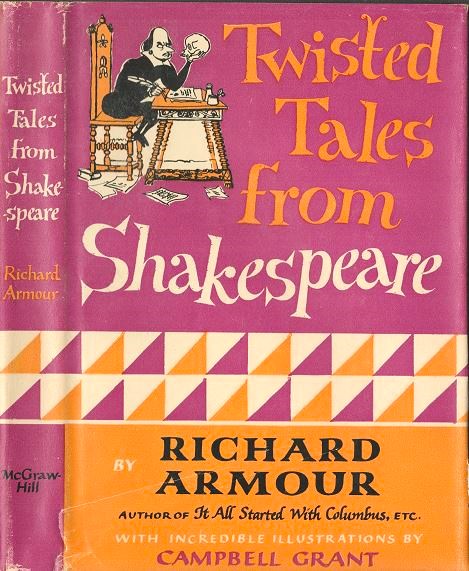
Then Armour topped himself with a series of books on literary history that surely reflected the works that he taught as an English professor to groups of college students. Twisted Tales from Shakespeare assumed a knowledge of Hamlet and Macbeth.


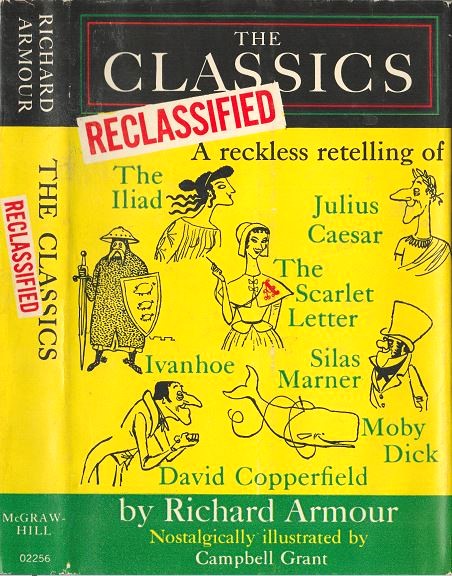
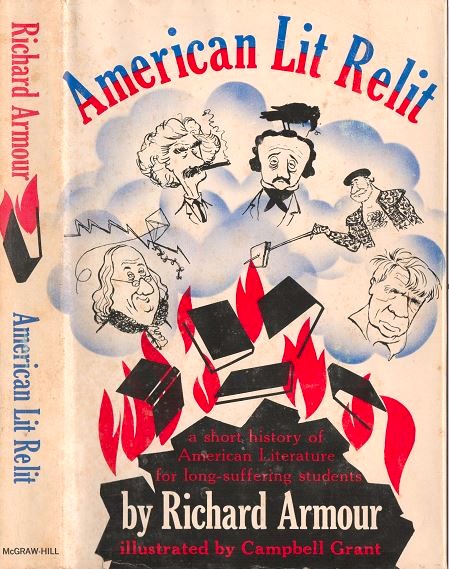
The Classics Reclassified isn’t readable without familiarity with the Iliad and Silas Marner; both American Lit Relit and English Lit Relit are like semester-long surveys of literature that cram dozens of books and authors into each.
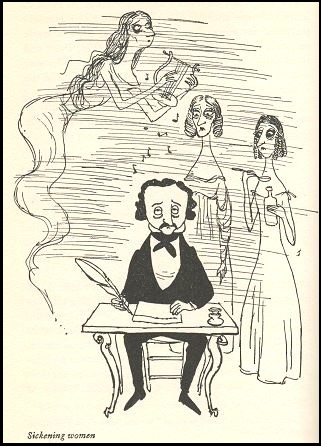
The audacity. No lowest common denominator humor here. Armour produced humor for educated audiences, readers who didn’t treat schooling as something to throw off the minute they left but people who embraced knowledge as a positive good to be revisited time and again. Yes, that 1950s version of history was still something mostly white and male and today’s history demands that other stories are told as well. Armour is dated; his love of learning should never be.

Bibliography of Humorous Works
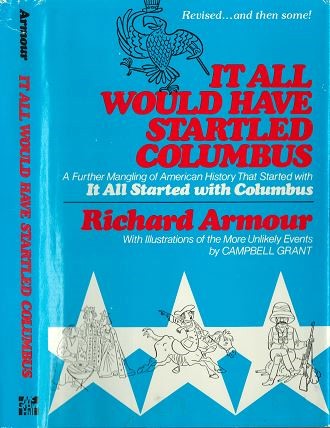
- 1953 – It All Started with Columbus, illustrated by Campbell Grant (rev. ed, 1961, 1971, 1976 as It All Would Have Startled Columbus)

- 1955 – It All Started with Europa (illustrated by Campbell Grant)
- 1956 – It All Started with Eve (illustrated by Campbell Grant)
- 1957 – Twisted Tales from Shakespeare (illustrated by Campbell Grant)
- 1958 – It All Started with Marx Campbell Grant)
- 1959 – Drug Store Days, illustrated by Catherine Barnes

- 1960 – The Classics Reclassified (illustrated by
- 1961 – A Safari Into Satire (limited edition published by the California Library Association as #2 in their Keepsake Series; consists of short excerpts of Armour humor and poems)
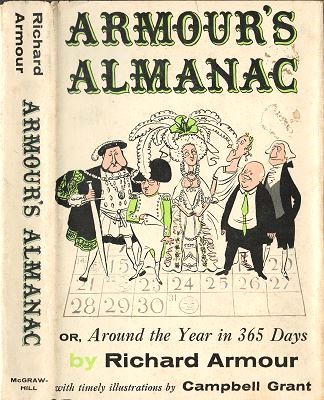
- 1962 – Armour’s Almanac; or, Around the Year in 365 Days (illustrated by Campbell Grant)
- 1962 – Golf is a Four-Letter Word (illustrated by Leo Hershfield)

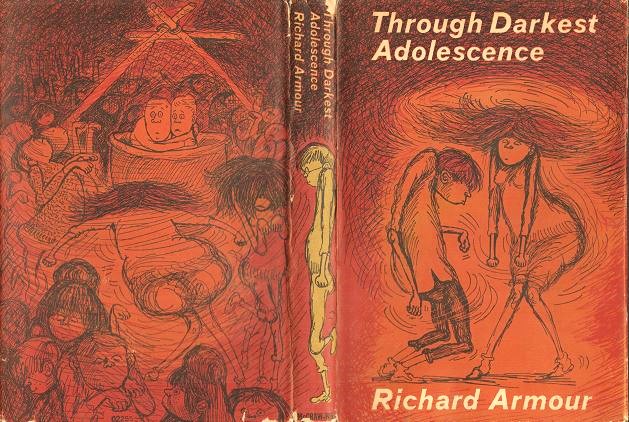
- 1963 – Through Darkest Adolescence (illustrated by Susan Perl)
- 1964 – American Lit Relit (illustrated by Campbell Grant)
- 1966 – It All Started with Hippocrates (illustrated by Campbell Grant)
- 1966 – Going Around in Academic Circles (illustrated by Leo Hershfield)

- 1967 – It All Started with Stones and Clubs
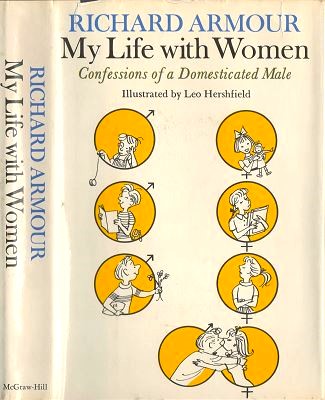
- 1968 – My Life with Women (illustrated by Leo Hershfield)
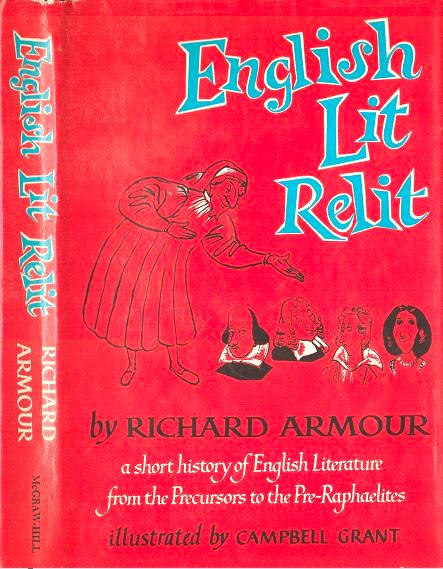
- 1969 – English Lit Relit (illustrated by Campbell Grant)
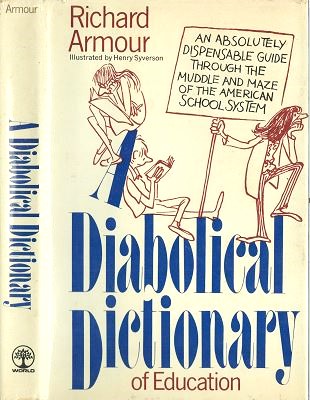
- 1969 – A Diabolical Dictionary of Education (illustrated by Henry Syverson)
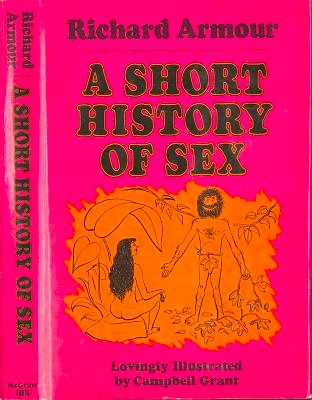
- 1970 – A Short History of Sex (illustrated by Campbell Grant)
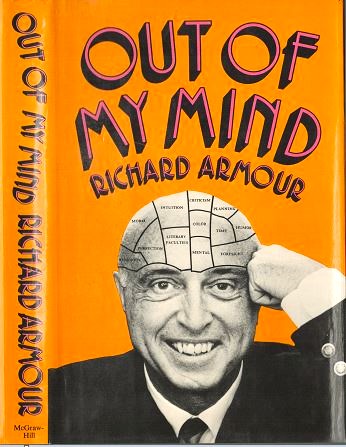
- 1972 – Out of My Mind
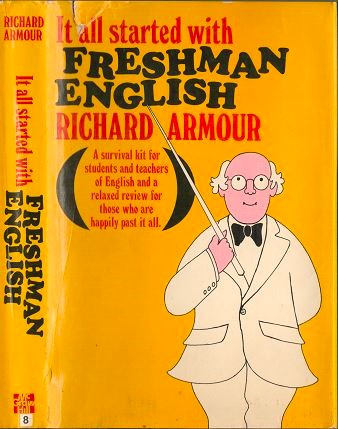
- 1973 – It All Started with Freshman English
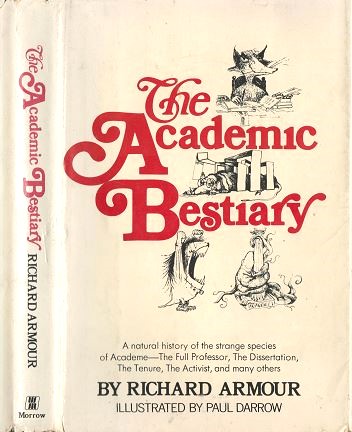
- 1974 – The Academic Bestiary (illustratee by Paul Darrow)
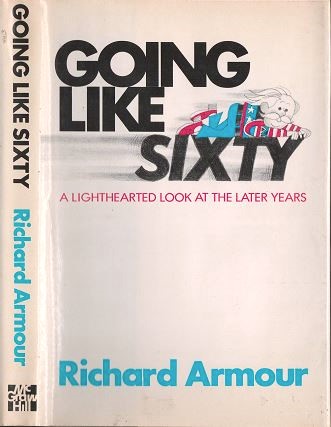
- 1974 – Going Like Sixty
- 1976 – The Happy Bookers: A History of Librarians and Their World (illustrated by Campbell Grant)
- 1977 – It All Started with Nudes (illustrated by Campbell Grant)
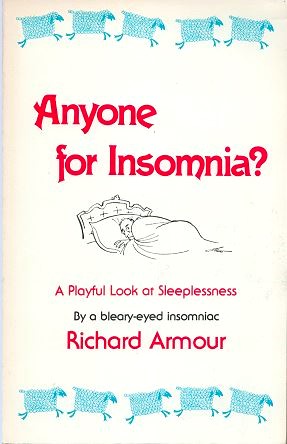
- 1982 – Anyone for Insomnia?


 Great Forgotten Humorists
You must be logged in to post a comment.