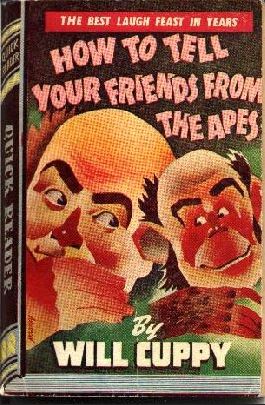
In the world of humor everyone and everything seems connected in far less than six degrees to everyone and everything else. When I was writing my Will Cuppy article, I discovered that his great book How to Tell Your Friends from the Apes had been reprinted in paperback all the way back in the mid-1940s. And not just by any ordinary publisher. By Royce Publishing of Chicago for their Quick Books series.
Quick Books were one of the oddest ventures in paperbacks even for a quirky field that no one quite knew how to exploit at the beginning. They had a mayfly’s life, a 1944 response to the paper shortages brought on by WWII that disappeared as soon as the war ended. All publishers were affected but no one else thought of Royce’s solutions. Quick Books were tiny, pocketbooks that could fit in almost any pocket, at a mere 3″ x 4.5″.
Moreover, they lived up to their name. Take a classic work like Emile Zola’s Nana, which can run 400-600 pages in various editions. Pocket Books put it into paperback in 1941 in a 447-page edition. Quick Books managed to squeeze it into their standard 128 pages. How? By abridging the hell out of it.
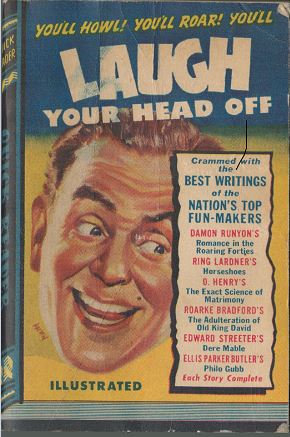
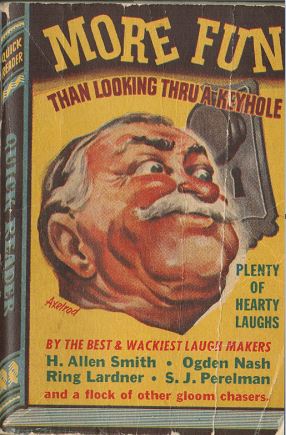
You get what you pay for. Pocket Books, just like virtually every other paperback in the 1940s, cost 25¢. Quick Books, on the other hand, went for only… Probably a dime. They didn’t have any prices on their covers. We don’t know for sure today what they cost. We don’t know almost anything about them.

Here’s a quick summary of everything we do know. The line first appeared in 1944… or maybe 1943. It lasted until 1945… or maybe 1946. The total output was 49 books, numbered 101-149. (Two Trophy Books were issued in 1946, but they were a larger size and a different name. They cost 15¢, which is why the regular smaller books are considered to have only cost a dime.) All the books had the same cover template, a really clever trompe l’oeil illusion of the spine and page bottoms of a normal hardback book.

Apparently the idea behind Quick Books was that readers would buy the books for themselves, then stick a stamp on them and mail them to the boys overseas. This was far from wild: many paperbacks of the era came with back covers urging readers to do the same. The small size of the books made them an even better fit than the official Armed Forces editions that the government itself sponsored. But the end of the war kiboshed that idea and Quick Books faded into the limbo traversed only by paperback collectors.
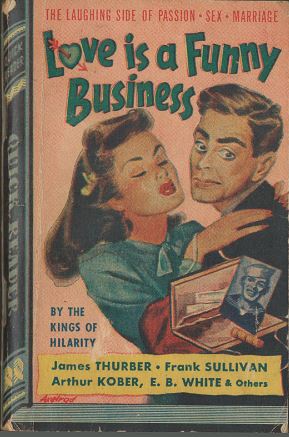
The overlap in the Venn diagram of paperback collectors and humor collectors is very small, but I fit into that tight space. Quick Books issued seven humor anthologies and I have all of them.

Look at the names on the covers! How could any lover of humor not trade one thin dime for a book like Bedside Bedlam, whose cover promised Robert Benchley, S. J. Perelman, Dorothy Parker, and Will Rogers? If they flipped to the table of contents they would also see Forgotten Humorist Frank Sullivan, Canadian giant Stephen Leacock, a poem from Don Marquis, the creator of Archy and Mehitabel, and a story from Ring Lardner. Plus funny stories from real doctors. Added bonus: crossword puzzles.

Then they were gone.
Short stories are not my province, but Quick Books also produced two such humor anthologies, #135 Humorous Ghost Stories and #143 Great Comedies Made Into Movies. Quick Books had a terrific list of books. Many are easily findable online. Good luck to anyone trying to put together a full collection, though.


 Great Forgotten Humorists
You must be logged in to post a comment.