It’s a tale as old as time or least the passage of the 19th Amendment. Bright young women, lured by dreams of becoming a writer and the thrills of sex and drugs and rock ‘n’ roll left their dull midwestern towns for the bright lights of the Big Apple. In the 1920s drugs meant the mysterious liquids passed off as alcohol in the ubiquitous speakeasies; rock ‘n’ roll meant hot jazz exemplified by the likes of Jelly Roll Morton; and sex meant exactly the same as it does today – men using their wiles to get close enough to women to break down their resistance, assuming they had any. Emily Hahn, a 23-year-old Chicago girl born in St. Louis, dreamed all those dreams and knew of a fairy godmother to help make them come true. Unlike 99% of her contemporaries, she had a New York connection: her equally beautiful sister Helen, the crossword editor at the New York Herald-Tribune who ran with the always-partying crowd of reporters, writers, editors, and all-around word people, a social segment that included but was much larger than the Algonquin Group. Emily toughed it out in cheap apartments, clung to the future promised by a few scattered sales, and danced with a different man each night, sometimes fending off their advances, sometimes not.
Men continually flung proposals at both women, with Helen more likely to say yes, especially if they were already writers. In 1928, shortly after Emily arrived, the married Helen flung off her husband to accept the proposal of the married writer and reporter Herbert Asbury. (Don’t ask me why Wikipedia doesn’t list their 16-year marriage.) Asbury not only encouraged Emily’s writing but suggested she adhere to the traditional “write what you know” and author a book about the dating scene she was immersed in.
She began writing a book about men at Asbury’s urging, drawing upon not just her experiences but also those of her four beautiful sisters, using a mock-scholarly format by classifying the gender into nineteen groups, each with a descriptive Type, a female Subject, and the Apparatus used upon them. Characteristically, she wrote everywhere, both in her tiny New York apartment, and in Taos, while renting a house from D. H. Lawrence and sharing it with the premier caricaturist of the 1920s, Miguel Covarrubias. Even as a penniless nobody, Hahn traveled with a series of future Wikipedia entries.
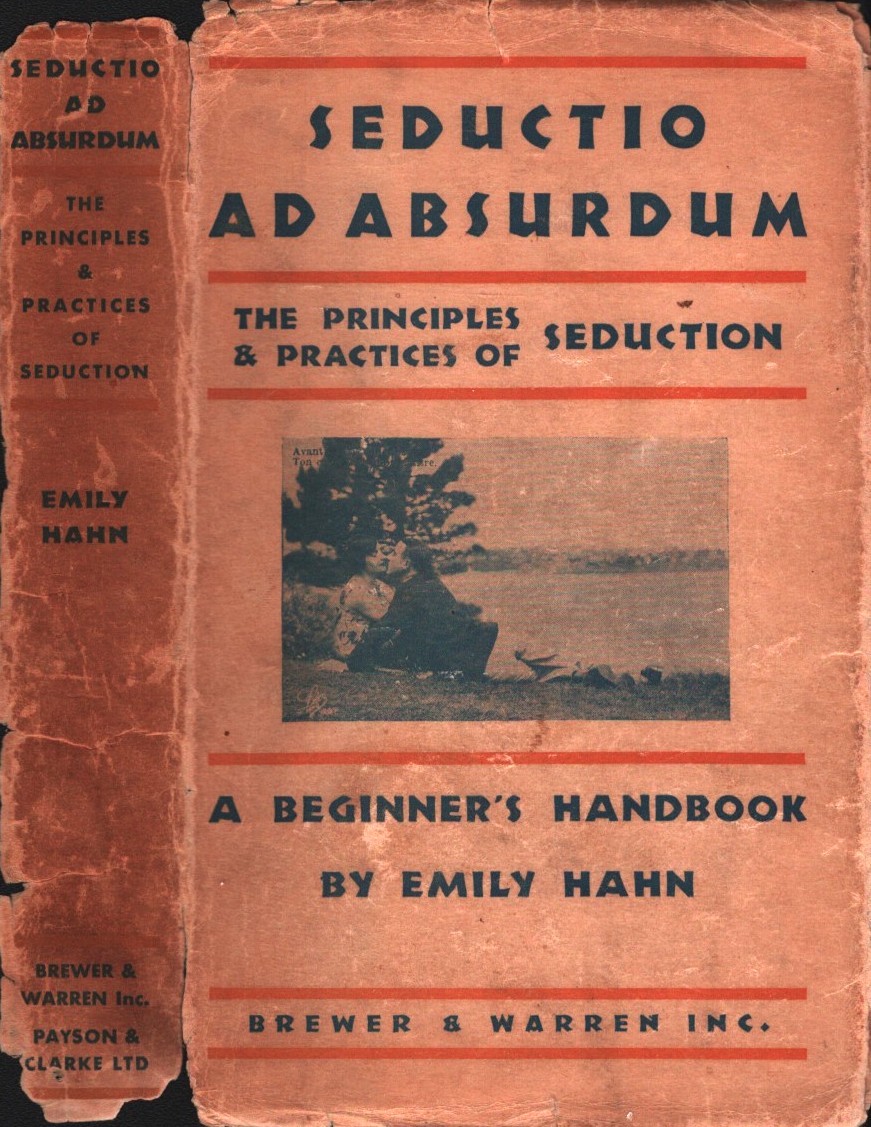
Seductio Ad Absurdum: The Principles & Practices of Seduction. A Beginner’s Handbook broke every norm when it finally hit bookstores on April 1, 1930. Young, single women simply did not talk about such matters openly, my dear, and the reviewers, virtually all men, handled the book as if with tongs. One could say that the title alone created a frenzy among bookbuyers, but that wouldn’t be strict truth. The first hit I could find of it in a newspaper database appeared in Walter Winchell’s column on March 17, a half sentence reading “it is hilariously funny stuff.” Winchell appeared in 1,000[!] newspapers, so the mere mention set off a frenzy like making Oprah’s Book Club. Hahn’s publisher ran to the presses for a “second printing before publication,” an almost unheard of honor for an unknown, presumably not mortified that Winchell had misspelled the title as Seductis.
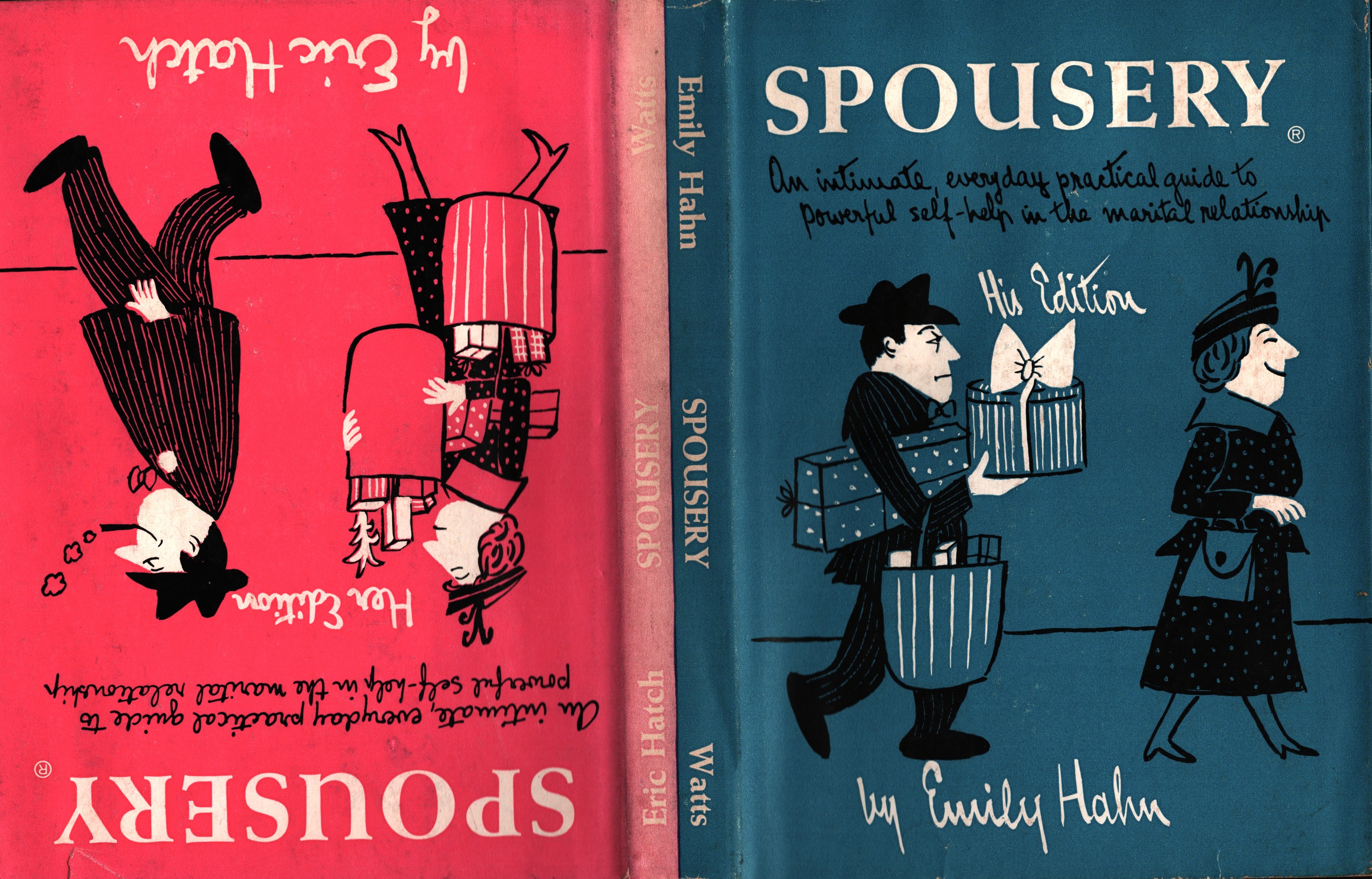
I already mentioned Hahn glancingly in Tété Béche Books, for her half of Spousery, an article published within hardcovers so technically a book, but, you know, not really, qualifying her for Singular Goodness. I looked up her biography, naturally, and got blown away. Hahn lived one of the most interesting lives any woman born in 1905 could possibly live. The rest of this article is me having fun living vicariously through her.
A biographer titled his book about her Nobody Said Not to Go, totally misdirecting the reader from her reality. Everybody in her long and productive life kept shouting Don’t Do It, You Fool, which only fed her implacable desire to forge ahead without a thought to consequences.
Freshman year at the University of Wisconsin foretold that headstrong existence. Hahn was shut out – directly by the Dean of the College of Arts and Sciences – from taking an inorganic chemistry course meant for engineering students. She sidestepped him, another presage of her future, by enrolling in the all-male College of Engineering, which went to the state legislature pleading for permission to expel her. That being against the school’s coeducational charter, a faculty member called her into his office to slap her in the face with reality. The quote below is from the biography mentioned above, by Ken Cuthbertson.
[Professor] Shorey explained there was no point in Mickey studying mining engineering because no mining company would ever hire her. When Mickey said she didn’t care, Shorey lost his cool. “It’s a waste of time, anyhow – your time and mine – because you won’t get your degree,” he blurted. When Mickey demanded to know why, Shorey got to the nub of it. “The female mind is incapable of grasping mechanics or higher mathematics or any of the fundamentals of mining taught in this course,” he said.
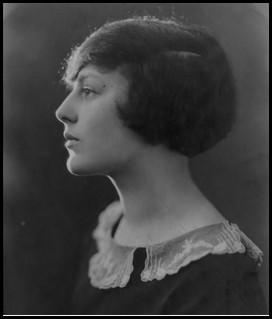
Hahn at 20
You already know what followed. Hahn took every course to earn a degree, and earn it she did, against the scorn and harassment of the men in the program, matching them indoors and outdoors stride by muddy stride until they very grudgingly gave their respect. Most knew to treat her a special, but equal, case, but there were exceptions. Mickey, a childhood nickname she didn’t use, resurrected itself because it sounded more masculine. She kept it to end of her life. Not every professor treated her the same way as the others, as it is very unlikely that any of the men lost their virginity to a mining professor, although the possibility cannot be disproven. Her feat of being the first women to receive a B.Sc. in mining engineering from the University of Wisconsin would be in the first paragraph of seemingly every one of the thousands of newspaper articles over the remaining seventy years of her life.
Technically speaking, Shorey’s prediction about job prospects foundered against Hahn’s being hired by a mining company in her native St. Louis. Dull reality meant she spent her time in a boring office job, never seeing the west. Yearning for fulfillment Hahn quit that job and a series of others that did no more than give her the clichéd writer’s biography of varied life experience as shown in the flap of Seductio.
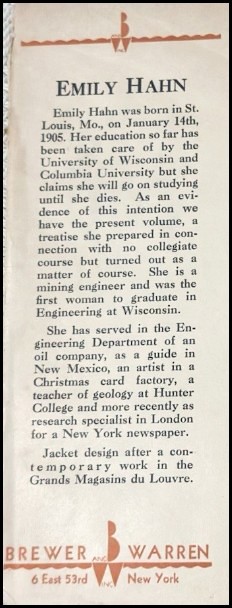
While a perfect resume for a book blurb, any deeper analysis would reveal a rootless, restless, often unhappy young woman, desperate for a sign of a positive future in a career she couldn’t yet quite bring within her grasp.
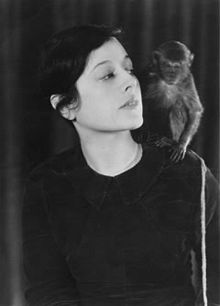
Three casuals sold to The New Yorker notwithstanding, no future as a New York writer loomed, and Seductio, mostly written in 1928, got postponed to 1930. Hahn took up residence with both David Loth (platonically, she said), a man who would become famous as a reporter and author of about 50 books, and her pet monkey, Punk, named by Asbury. Hahn would always have a pet monkey or small ape on her shoulder. She left Loth for an apartment with a roommate who fled back to the midwest after an abortion that killed her dreams. Hahn sank into a depression that resulted in a serious suicide attempt.
She too decided she had to get out of New York and took up Loth’s offer to accompany him to Europe as the research assistant on a book. While there she started a lifelong friendship with the equally rebellious reporter/author Rebecca West, met another rolodex of famous names, and grew infatuated, platonically again, with Patrick Putnam. Putnam, an anthropologist, planned a return to the Belgian Congo to do volunteer medical work with the Belgian Red Cross. Putnam, of course, became sufficiently important to merit a biography of his own.
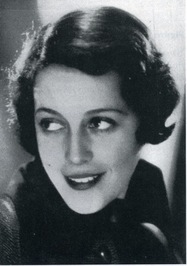
First, though, Hahn sailed home for the Seductio book tour. One reporter described her as “like a cool-dark disdainful stranger who had wandered rather casually down from Olympus for an hour’s call.” Another said she looked like “a high school student, rosy cheeked, and refreshing, with dark eyes and crinkly brown bob.” Hahn could easily embody both sides of the coin but the real lesson is to never trust a reporter’s glamorization of a subject.
Hahn returned, unfulfilled, to London. Sure, she wrote a novel or two over the year, but travel lust prevailed. She decided, unasked and unplanned, to join Putnam in the Congo. One harrowing journey later, she reached Putnam living with the Bambuti pygmies in the Ituri Rainforest [now part of Zaire]. Drifting again, Hahn spent a year aiding him. For once slow on the draw, she only gradually came to realize that his relationship with his three pygmy wives was much like that of an antebellum plantation owner, abject cruelty mixed with occasional affection. After finding one chained to a tree, Hahn up and left.
One did not up and leave in the Ituri Rainforest. Hahn had little money and no transportation. Worse, she felt she couldn’t leave behind a four-year orphan, dubbed or perhaps daubed Matope, meaning mud, who had attached to her after she nursed him back to health. I should also mention that she took her pet baboon Angélique. The resulting trip across footpaths took eighteen days just to get to a road that carried vehicles. Hahn eventually returned to London and one random day in a café struck up a conversation with a man who spoke Swahili. By sheer coincidence that could happen to anybody, the man, Jomo Kenyatta, would three decades later become he became president of Kenya. Hahn published Congo Solo: Misadventures Two Degrees North in 1933, the first of her many books about other lands. (Weird footnote. Putnam escaped world scorn because under pressure Hahn rewrote him into a different character. Mere months after Hahn fled, Putnam married a white American who died of pneumonia only three years later. He then contacted Hahn and asked her to return to the Congo and become his real wife. She obviously said no yet allowed him to be honored for his African work the rest of his life.)
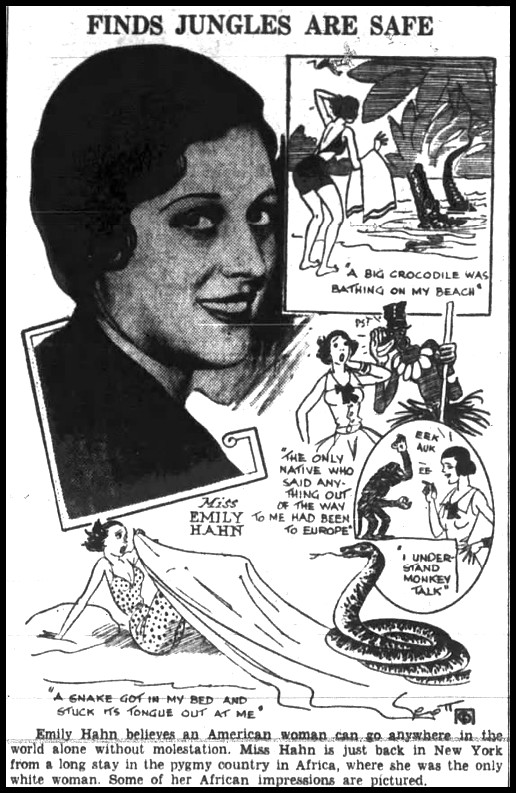
All this was prelude to considerable fame paired with notoriety. Just turned thirty and still restless, Hahn sailed for Shanghai in 1935 with sister Helen. No modern comparison can do justice to the unique status of the world’s fifth largest city. Ever since China lost the Opium Wars it had conceded land and control of Shanghai to foreign governments who ruled from aptly named Concessions where they were immune from Chinese laws. A parallel system of crimelords and oligarchs like the Sassoons and Kadoories, whose families had made their fortunes transporting opium, dominated the otherwise oppressed millions of native Chinese. The two systems rarely overlapped. Leave it to Hahn to find the intersection of that Venn diagram.
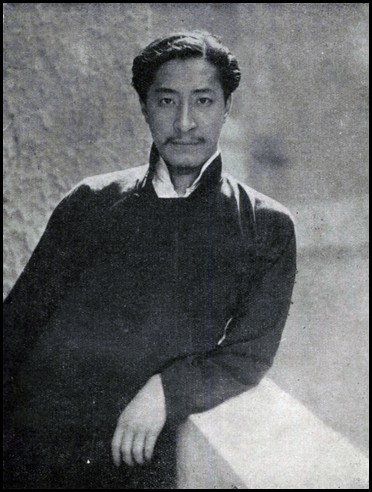
Wealth on both sides had privileges other than corruption; Thirties Shanghai burst with magazines, books, movies, fashion, and nightlife in ways similar to those of post-WWI Paris and Weimar Germany. At one party she met Sunmei Zau (today transliterated as Shao Xunmei), member of a family so wealthy that he received an elephant as a fifth birthday present. He was shipped off to Europe after several scandalous affairs, including one with the Chinese actress White Lotus. Zau was seventeen. On his return he led a life of such dilettantish intellectualism it’s surprising he didn’t have a secret identity as a crimefighter. Hahn left the party with Zau, starting a very public affair lasted years even though he was five (and a half) children deep into an arranged marriage with a cousin. Their children called Hahn “Mickeymama.” Zau also had a severe addiction from the opium that was still rampant in China, and, in tragically clichéd fashion, drew Hahn into that life despite everybody warning her not to. She would eventually be up to twelve pipes a day, doing serious damage to her body while simultaneously insisting that she could stop at any time. Despite and because of the deepening addiction, Hahn furiously wrote stories and articles for The New Yorker to make the money she needed to maintain her free lifestyle. A long series about a “Mr. Pan,” who everybody in Shanghai knew was Zau, straddled the line between reporting and fiction. Intrigued Americans fascinated about China devoured the stories, which were eventually collected into a book.
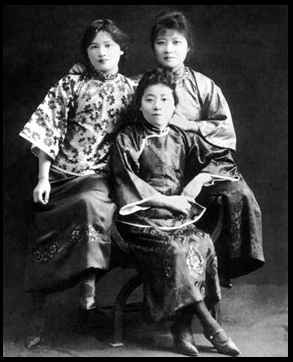
Another book stemmed from Hahn’s connection to three of the most famous women in the world: the Soong Sisters. Ai-ling, the oldest, married H. H. Kung, governor of the Central Bank of China; middle child Ching-ling married Sun Yat-Sen, the founder of Nationalist China; Mai-ling, the youngest, married Chiang Kai-shek, who carried Chinese nationalism onto Taiwan after the Communist takeover. Each sister was tremendously powerful and influential in their own right, although few outsiders knew anything in depth about their lives, a deliberate and thorough act of privacy. Zau’s aunt happened to a childhood playmate of Ai-ling, giving them an in. Found acceptable, Hahn diligently interviewed and researched them for a major book called simply The Soong Sisters, published in 1941.
Nothing kills a party more than an invasion by totalitarian sadists. The Japanese invasion of China in 1937 left them in control of Shanghai and broke the power of wealthy Chinese. Zau wound up nearly bankrupt, with Hahn contributing to his family’s expenses. She and Zau had acquired a rare printing press to launch a literary magazine. His wife had a brilliant idea to save it: Hahn should marry Zau, since the Japanese were not yet confiscating property owned by foreigners. Polygamy remained legal under Chinese law, although not recognized elsewhere. A “marriage” was soon arranged. A perverse outcome of the sham marriage saved Hahn in 1942. When it had become apparent she could no longer stay in Shanghai she moved to Hong Kong, to relative safety shattered when Japan attacked Pearl Harbor. American citizens were being forcefully deported, but Hahn had a powerful reason for staying. A friend suggested a loophole: wives were the “property” of their husbands. Wives of Chinese men were not Americans in that regard. Another rescue via the bizarre bureaucratic rules she normally hated.
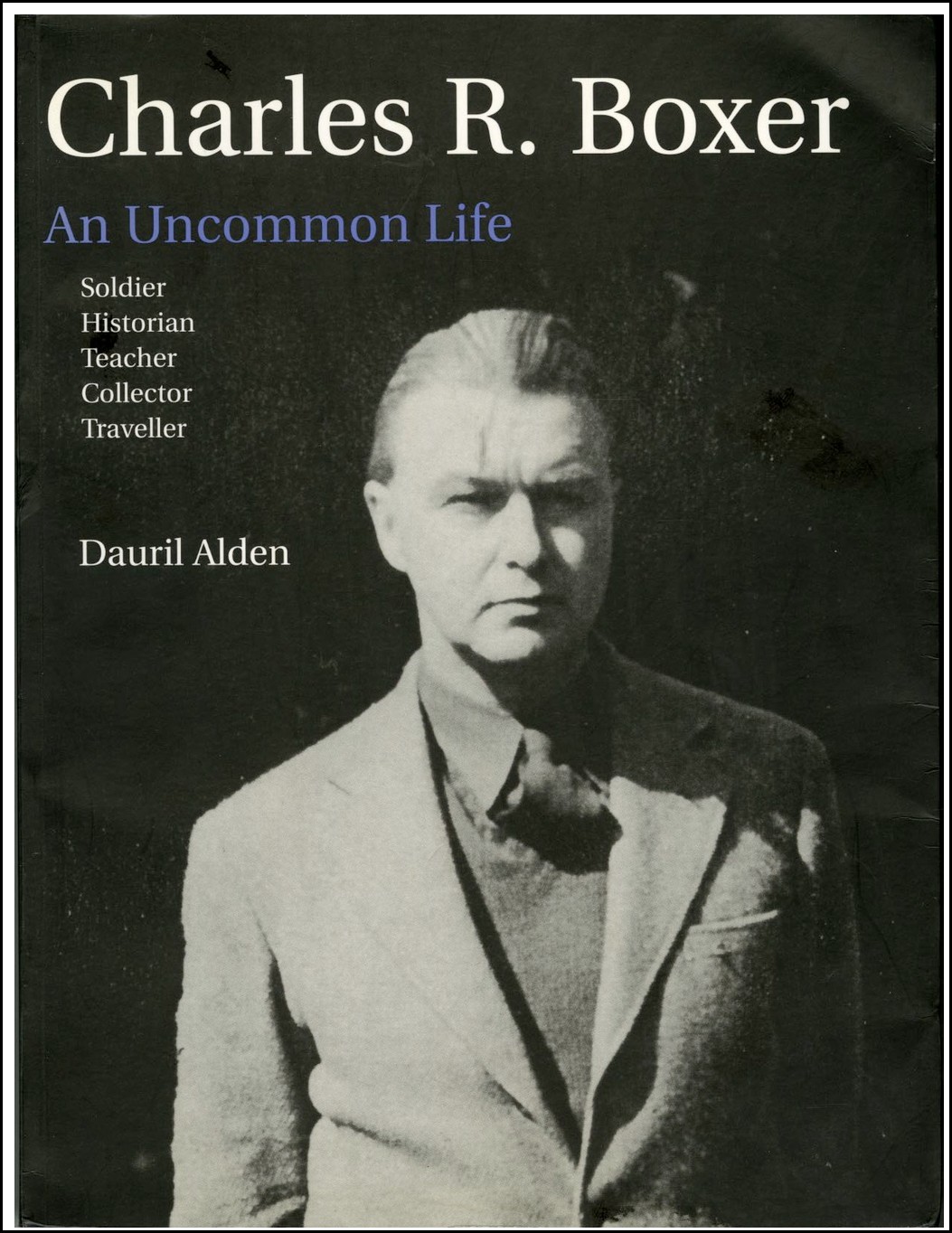
That child, Carola, born in 1941, was not Zau’s. In Hong Kong Hahn began an affair with perhaps the worst choice possible: the head of local British intelligence. Charles Boxer, only a year older than Hahn, was career military as well as a noted historian whose collection of rare books was taken by the Japanese for the Imperial Library. Recently married to “the most beautiful woman” in Hong Kong, he was an intellectual on Zau’s level who needed a free-spirited and equally literary American. His wife saw that immediately and gracefully turned Boxer over to Hahn before leaving for Australia.
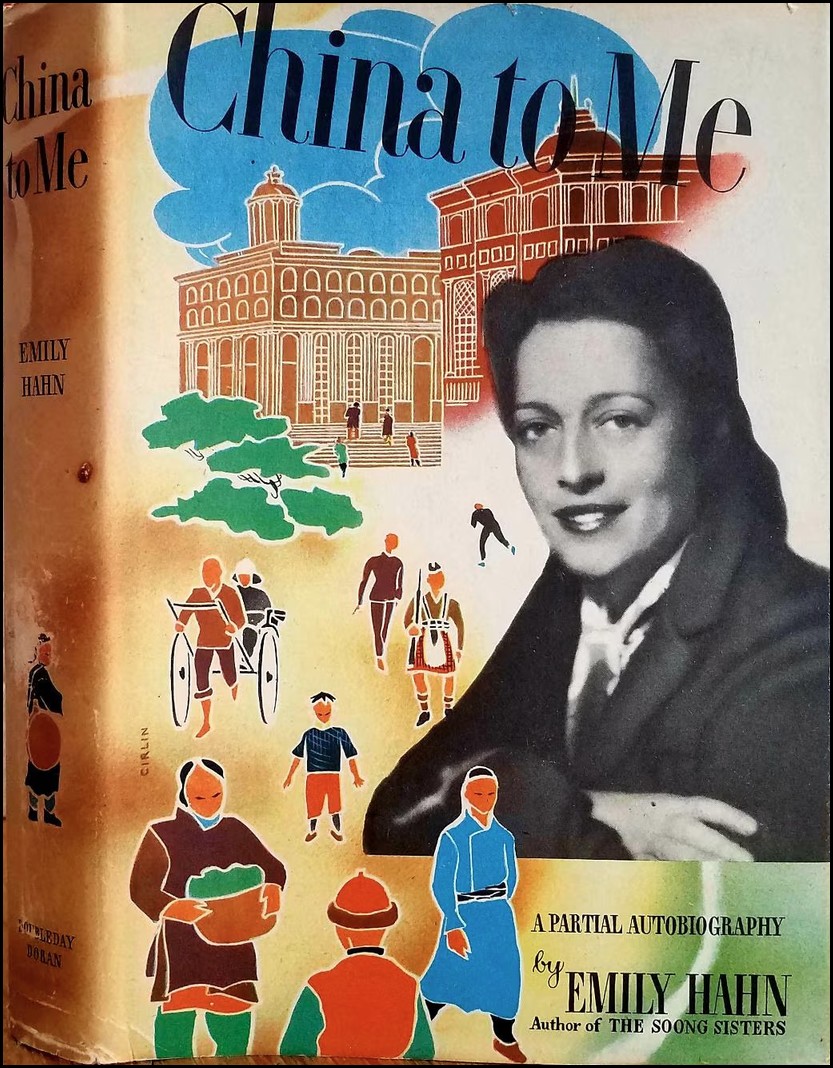
All this attention to Hahn’s sex life is vitally important for the ways it changed her life, sometimes protecting her, sometimes endangering her, and forever marking the way she challenged the world. The Japanese attacked Hong Kong the day after Pearl Harbor. Boxer was seriously wounded in battle and moved to a Japanese prison hospital, where the inmates were systematically starved. Hahn contrived ways to bring him food without ever actually seeing him, determined to be of any help she could by postponing her own removal. The next two years were desperate deprivation, a constant struggle to find baby food for Carola and adult food for Charles besides her own needs. The Soong Sisters had been a bestseller, but all money coming from America was blocked. In late 1943, faced with taking Carola to an internment camp or leaving on the last prisoner exchange ship she bowed to reality and left Boxer behind. China to Me: A Partial Autobiography made a sensation when published in 1944.
Boxer survived the war and they married soon after his release. A second child, Amanda, was born in 1948. Hahn, by inclination or memories of being smothered by her mother or the trauma of the Hong Kong years, didn’t see herself as a regular mother. Boxer raised the children in England; Hahn lived in New York, residing in Britain for 90 days a year to avoid taxes. She never learned to cook.
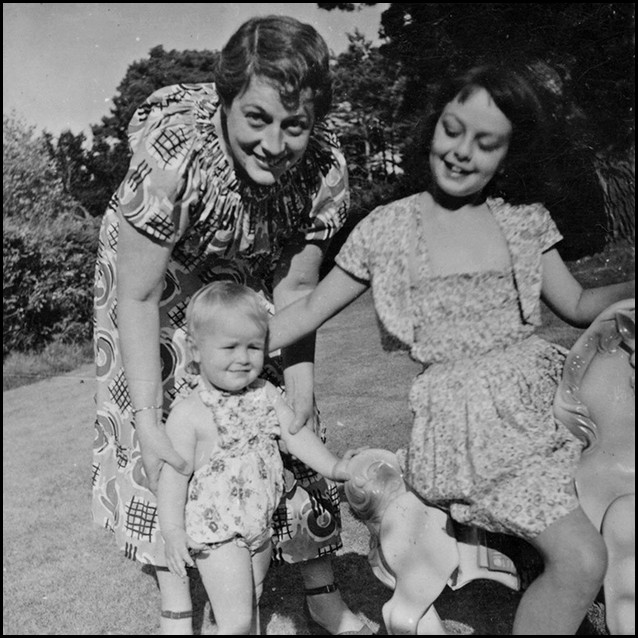
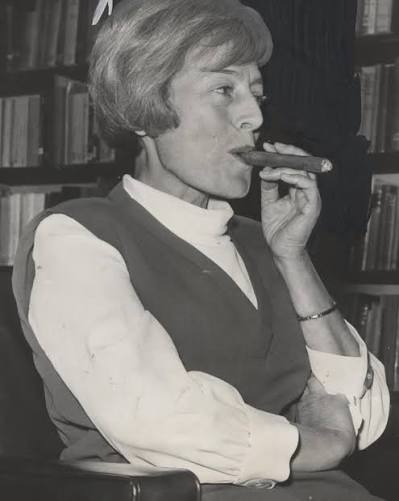
Always, always restless Hahn wrote, traveled, wrote, smoked her large black cigars, wrote, and turned her love for primates into her cause, championing zoos, wildlife preservation, and animal communication. “Either you have gibbons in your blood or you don’t,” she once wrote. Her last book, Eve and the Apes, released when she was 83, featured the careers of more than half a dozen other women who loved apes as much as she did.
Hahn’s longtime colleague at The New Yorker, Roger Angell, devoted a short chapter to her in his memoir Let Me Finish.
[Hahn] was the magazine’s roving heroine, our Belle Geste: a reporter inadvertently at large, whose work, arriving from all continents, encompassed a hundred and eighty-one pieces and eight decades. Her dateline, taken together with her smashing good looks – enormous, green-flecked dark eyes; an oval face; a plungingly intelligent gaze; and a generous mouth always on the edge of an arriving smile or giggle are misleading, suggesting another trenchcoated, news-hungry gal reporter among the guys, a Jean Arthur, or perhaps a beautiful thrill-seeking flibbertigibbet, a Carole Lombard. She was something more rare: a woman deeply, almost domestically, at home in the world.
Bibliography of Humorous Works
- 1930 – Seductio Ad Absurdum: The Principles & Practices of Seduction. A Beginner’s Handbook
- 1956 – Spousery: His Edition by Emily Hahn b/w Spousery: Her Edition by Eric Hatch


You must be logged in to post a comment.